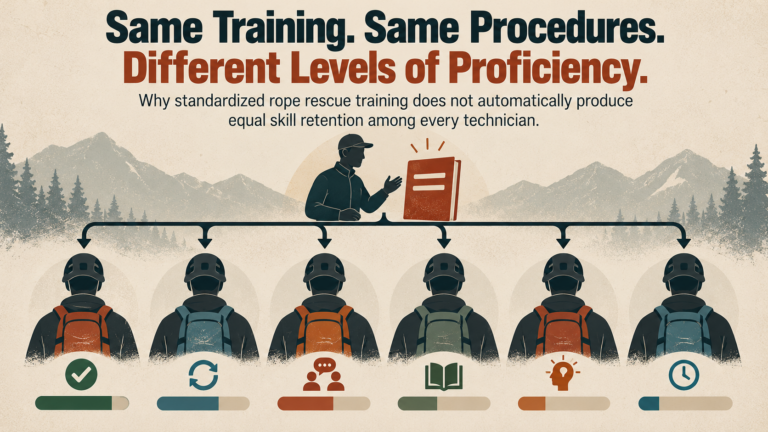
Same Training. Same Procedures. Different Levels of Proficiency.
Why standardized rope rescue training establishes a common foundation, but maintaining individual proficiency requires continuing attention.
One Department, One Standard
A well-organized rope rescue department operates from a common set of procedures. Its personnel train with approved equipment, follow established operational guidelines, and learn the systems their organization has selected for rescue operations. Regardless of shift assignment, technicians are expected to understand the same procedures and demonstrate the capabilities required for their responsibilities.
This common foundation is essential. It allows personnel to work together, recognize established system configurations, anticipate operational sequences, and evaluate equipment against shared expectations. Individual rescuers may bring different experiences and technical interests to the team, but those differences do not grant them authority to independently alter the department’s accepted operating procedures.
Nevertheless, a distinction remains between establishing a common training standard and maintaining consistent proficiency among everyone trained to that standard.
Technicians arrive with different experience levels, develop skills at different rates, and encounter different opportunities to reinforce what they have learned. Some regularly practice specialized rescue techniques, while others may have limited exposure to particular operations between scheduled training events.
The challenge for a training officer is therefore not necessarily getting every shift to use the same procedures. A properly managed department already addresses that through its instructional program and operational guidelines. The more revealing question is whether every technician retains the knowledge and skills needed to perform those procedures effectively when required.
What a Fire Department Actually Discovered
In 2015, Kris Jungels conducted an evaluation titled The Effectiveness of the Rochester Fire Department Rope Rescue Training Program for the Rochester Fire Department in Minnesota.
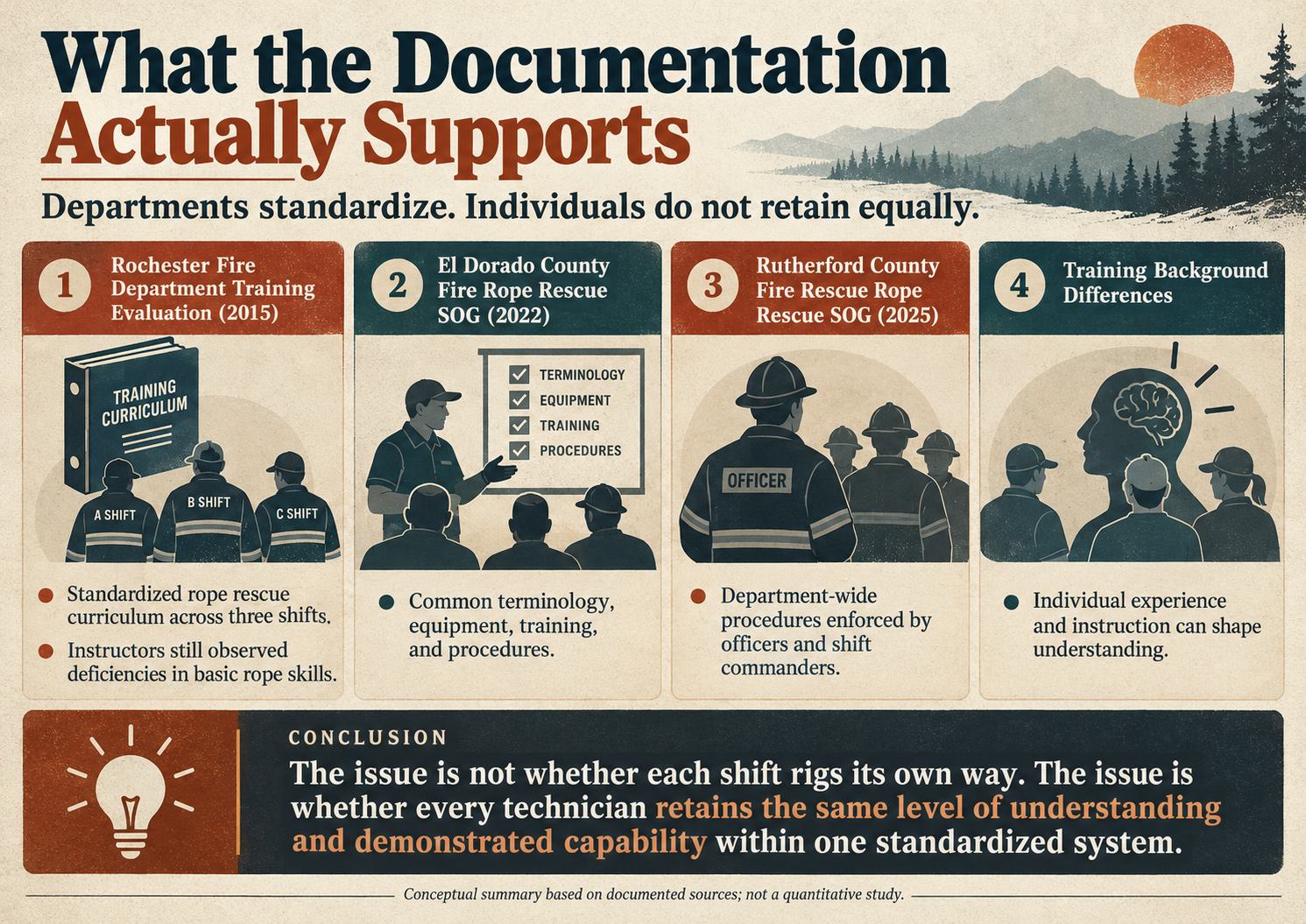
The department had established a Rescue Group in 2010 to develop and deliver a standardized curriculum. Its instructional team included representatives from all three shifts, along with training and command personnel. The resulting program covered fundamental rope rescue skills, including knots, anchors, belay operations, mechanical advantage, and rappelling.
Rope rescue instruction was offered several times annually, with a repeating curriculum designed to provide consistent training throughout the department.
Despite this structure, instructors had observed recurring mistakes involving basic skills that personnel had previously been taught. Rather than assuming the problem was inadequate instruction or individual indifference, the department undertook an evaluation to determine what personnel could actually demonstrate.
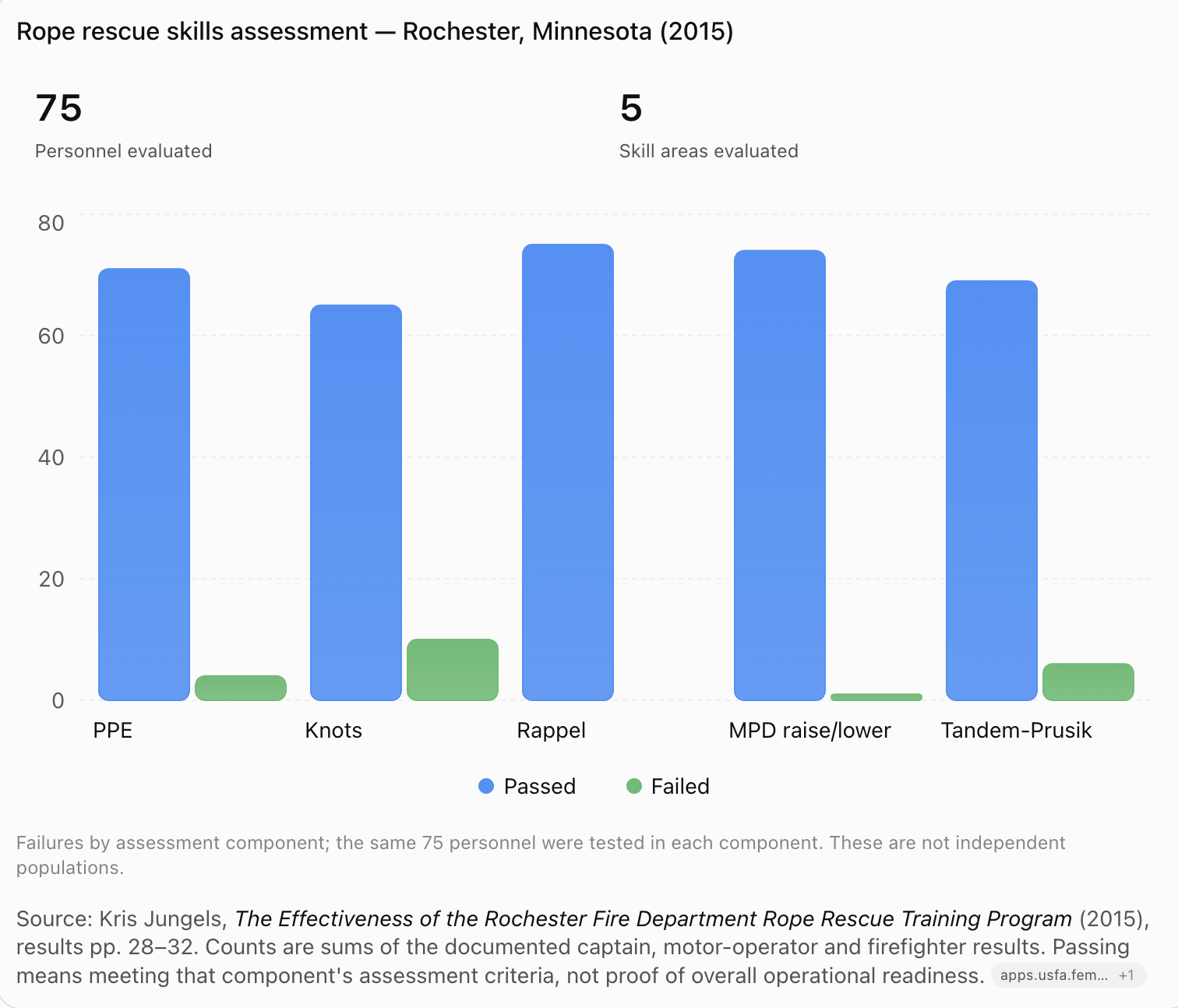
Seventy-five members participated, including captains, motor operators, and firefighters. The evaluation examined personal protective equipment, knot tying, rappelling, raise/lower operations using an MPD, and tandem-Prusik belay procedures.
The results were revealing without being uniformly negative.
Most personnel demonstrated satisfactory performance across the evaluated skills. However, ten participants failed the knot-tying portion, six failed the belay portion, and one failed the MPD raise/lower assessment. All 75 passed the rappel evaluation.
These were not differences in departmental procedures. The personnel were being evaluated against the same established requirements.
The researcher’s conclusion recognized that the training program had generally been effective in developing and maintaining basic rope rescue skills, while also identifying deficiencies requiring additional attention.
This distinction is important because it demonstrates both the value of standardized training and the necessity of continuing evaluation. A successful training program can produce substantial competence without eliminating every individual performance gap.
The Difference Between Participation and Proficiency
Training attendance provides a record of participation. Course completion establishes that an individual met the specified requirements at a particular time. Practical evaluation offers additional evidence of what that individual can presently demonstrate.
These measures are related, but they answer different questions.
A technician who successfully completes an introductory rope rescue course may retain a strong understanding of knots and equipment inspection while becoming less practiced in a seldom-used belay procedure. Another technician may remain comfortable operating rope-control devices but require additional review of the mechanical relationships within a hauling system.
The point is not that every person inevitably loses the same skills. Research on skill retention indicates that performance depends on several factors, including the quality of initial learning, subsequent practice, experience, task complexity, and the conditions under which a skill must be recalled.
The Rochester evaluation illustrates why assumptions about proficiency should be replaced with direct observation whenever practical.
It also provides an encouraging perspective. When an assessment reveals a particular weakness, the training program gains information that can be used to improve future instruction. Rather than requiring everyone to repeat material unnecessarily, instructors can concentrate attention where evaluation demonstrates a need.
This is one of the most productive purposes of continuing training: to preserve established capabilities while identifying opportunities for deliberate improvement.
A Technical Example: Knowing the Belay Versus Operating It
Belay operations provide a useful illustration of the difference between understanding a procedure and demonstrating proficiency in its execution.
A technician may correctly describe the purpose of a belay system, identify the required components, and explain its relationship to the primary working system. Those are important elements of technical knowledge.
However, operating the belay introduces additional requirements involving equipment handling, rope management, correct device operation, communication, and recognition of the conditions under which the system must perform.
In Rochester’s evaluation, six participants did not meet the required criteria for the tandem-Prusik belay exercise. The result does not establish that these individuals lacked all understanding of belay principles, nor does it identify one universal cause for their errors. It establishes that specific performance requirements were not demonstrated during the assessment.
That is precisely the information a responsible training program needs.
The same distinction applies to more complex arrangements. A technician studying twin tension rope systems must understand the intended behavior of both working lines, how control devices interact with the operating system, and how changes in loading or movement affect the complete arrangement.
Academic understanding and practical performance reinforce one another, but neither should be assumed simply because someone attended the appropriate course.
Maintaining Knowledge Between Training Events
Our earlier RLA article, Why Rope Skill Fades Between Certifications, examined the broader problem of skill retention. The concern extends beyond forgetting particular procedures to include the gradual weakening of knowledge and capabilities that are not regularly reinforced.
Research examining first-responder skill maintenance recognizes that individuals differ in their opportunities for practice, previous experience, and ability to retain particular skills. Effective refresher programs must account for those differences while maintaining the organization’s required performance standard.
This creates an important opportunity for both technicians and training officers.
A department can continue teaching and practicing its established procedures while providing additional opportunities for individuals to revisit technical principles between scheduled practical evolutions. Review of system behavior, load paths, mechanical advantage, anchor geometry, and equipment limitations can help maintain the knowledge that supports successful hands-on performance.
For example, RLA’s technical material on mechanical advantage examines how force is developed and distributed through different hauling arrangements. Its discussions of twin tension systems and complete-system evaluation explore the relationships between components, operating responsibilities, and system behavior.
These resources do not replace an organization’s approved training procedures. Their educational purpose is to reinforce the technical principles technicians rely upon when working within those procedures.
An instructor can use such material to prepare personnel for practical exercises, revisit concepts identified as weaknesses during evaluation, or encourage technicians to examine why their established systems function as intended.
Turning Evaluation Into Improvement
One particularly useful finding from the Rochester study concerned personnel responses following their practical evaluations.
Of 62 respondents to a follow-up questionnaire, 47 reported that participating in the assessment, together with any preparation or review they had completed, helped them become more proficient in basic rope rescue skills.
That result describes the participants’ perceptions, not a measured improvement in subsequent performance. Nevertheless, it suggests that the evaluation process was regarded as beneficial by many of those involved.
The larger lesson is that assessment can contribute to learning when it is treated as part of professional development rather than simply an examination of past performance.
For a training officer, the information gained through evaluation can help direct future practice. For an individual technician, it can clarify which skills are well established and which deserve renewed attention.
The objective is not to produce identical experience or ability across every member. It is to ensure that personnel meet the proficiency expectations appropriate to their assigned responsibilities within a common operational system.
That requires a continuing relationship between technical education, supervised hands-on practice, performance assessment, and corrective instruction.
A Shared Standard Supported by Continuing Education
Rigging Lab Academy’s CORE membership supports the academic portion of this process through its Classic Courses, technical Playlists, and extensive rope rescue and rigging knowledge resources.
These materials provide technicians with opportunities to revisit fundamental principles, examine specialized systems, and prepare for training conducted under their organization’s procedures and qualified instructors.
They are not substitutes for practical qualification, certification, or demonstrated operational capability. Instead, they support the technical understanding that helps make recurring training meaningful.
A standardized department already possesses an important advantage: its personnel share a recognized set of procedures and operating expectations. Continuing education helps preserve the knowledge underlying those procedures, while practical evaluation establishes whether the required capabilities remain available.
The Rochester research demonstrates that these two responsibilities belong together. Its findings showed a generally effective training program alongside specific individual deficiencies that could be identified and addressed.
That is not evidence of a broken system. It is evidence of why evaluating a functioning system remains worthwhile.
The objective of continuing rope rescue education is to strengthen an established foundation, support individual professional development, and help each technician remain prepared to perform within the team.
The procedures may be common to everyone. Maintaining the ability to carry them out is a continuing responsibility shared by the technician and the organization.
Peace on your Days
Lance
Research documentation
Primary rope rescue study: Kris Jungels (2015), The Effectiveness of the Rochester Fire Department Rope Rescue Training Program. Executive Fire Officer Program, United States Fire Administration. Rochester, Minnesota.
Supporting research: Understanding Skill Decay and Skill Maintenance in First Responders, Australian Journal of Emergency Management (2021).
Related RLA publications: Why Rope Skill Fades Between Certifications and Building Rope Rescue Team Competency.
Continuing education: Rigging Lab Academy CORE — Technician and Crew memberships.