Mitigation of System Overpowering and Anchor Failure in Raising Operations
1. Purpose and Strategic Objectives
In technical rescue, the transition from a static load to a dynamic raise represents a critical escalation of risk to both system integrity and personnel safety. This operation must be evaluated through the Conservation of Energy. While mechanical advantage (MA) reduces the input force required by the haul team, it does not reduce the total work required:
Work = Force × Distance
Energy is not lost in an inefficient system—it is converted into friction, heat, and structural stress. These conversions increase anchor loading, hardware wear, and the likelihood of catastrophic failure.
Primary Objective
This SOP establishes a shift from a brute-force hauling mindset to a Calculated Tension Framework, where force generation is deliberate, measurable, and bounded.
Operational Scope
-
Establishes non-negotiable limits for:
-
Manpower allocation
-
Mechanical advantage ratios
-
System safety indicators
-
Safety Philosophy
-
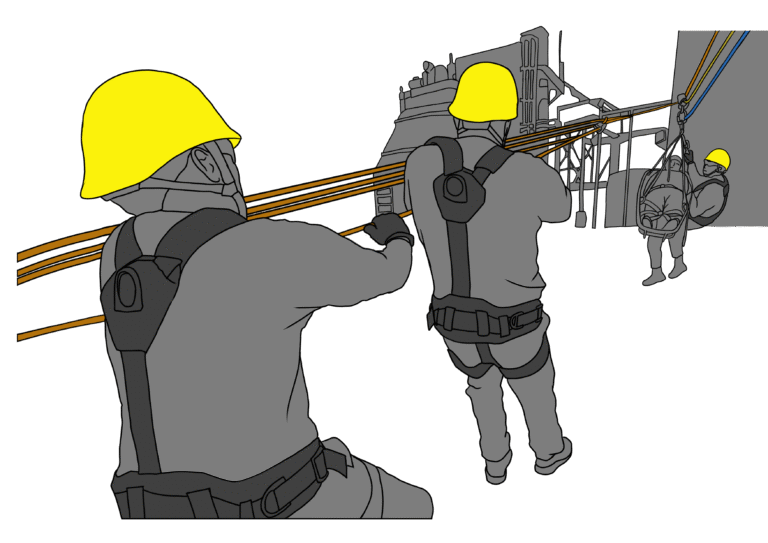
Raising operations are inherently higher risk than lowering because they involve the active generation of kinetic energy against gravity.
-
Uncontrolled hauling results in an “explosion of power,” where motivated teams unintentionally exceed system safety margins—often leading to anchor, hardware, or structural failure.
2. Technical Foundations: Force, Work, and Vector Analysis
Strategic safety begins with strict adherence to physical law. Guesswork in force estimation is the primary precursor to system failure. All field calculations shall be conducted in kilonewtons (kN) to maintain consistency with hardware ratings.
Fundamental Units
| Unit | Definition | Operational Context |
|---|---|---|
| Force (kN) | A push or pull, experienced as tension or compression | 1 kN ≈ 100 kg mass under gravity (≈ 220 lb) |
| Work | Force applied through distance | Constant in a closed system; MA redistributes effort |
| Mass (kg) | Amount of matter | Used only to derive force |
| Weight (N / kN) | Force exerted by mass under gravity | Baseline load for all rigging analysis |
Vector Mechanics and Resultants
-
Force is a vector quantity (magnitude and direction).
-
All rigging analysis must identify the resultant vector—the single force representing net magnitude and direction.
-
The centerline of a loaded pulley or connection point always aligns with the resultant force acting on its anchor.
Scalar vs. Vector Awareness
-
Rope length, haul distance, and system travel are scalars.
-
System safety is governed by vectors.
-
Rope path—not rope count—determines where structural stress is applied.
3. Structural Integrity: Anchor Design and the ERNEST Mandate
Anchors are the foundation of every rescue system. Failure at the anchor nullifies all mechanical advantage.
Every anchor system shall comply with ERNEST:
-
Equalized – Load distributed as evenly as possible
-
Redundant – Single-point failure must not cause collapse
-
Non-Extending – No shock loading upon component failure
-
Solid – All points unquestionably strong
-
Timely – Built efficiently to support patient care priorities
Geometric Force Multiplication
Anchor geometry directly amplifies force:
-
90° angle → each leg carries ~71% of the load
-
120° angle → each leg carries ~100% of the load
-
150° angle → each leg carries ~200% of the load
CRITICAL WARNING
-
Anchor leg angles exceeding 120° are prohibited.
-
A 1:1 change-of-direction pulley with parallel lines (0°) places 200% of the load on its anchor.
-
Every redirect is a potential anchor-loading hazard and must be justified and evaluated.
Artificial High Directionals (AHDs)
AHDs function as levers.
The resultant force vector must remain within the footprint of the device to prevent torque, bending, or structural failure.
4. Mechanical Advantage Analysis and Calculation
Mechanical advantage trades distance for force. Excessive ratios slow operations and increase reset frequency, often reducing overall efficiency.
Theoretical vs. Practical MA
-
TMA: Frictionless ideal
-
PMA: Real-world output
-
Example: A 3:1 Z-rig commonly delivers only ~2.2:1 PMA due to friction.
Mandatory T-Method Analysis
All compound and complex systems shall be analyzed using the T-Method:
-
Assign 1T to the haul line
-
Trace rope through each pulley (tension remains equal)
-
Sum all T-units reaching the load to determine MA
-
Mandatory Safety Check: Sum all T-units reaching the anchor
-
Example: A complex 5:1 may impose 6T on the anchor
-
System Classification
-
Simple Systems
-
All moving pulleys travel with the load
-
Fast to build, easy to manage
-
-
Compound Systems
-
One simple system pulls another
-
High power, slower resets
-
-
Complex Systems
-
Pulleys move at different speeds or directions
-
Efficient but collapse rapidly, increasing team fatigue
-
5. Operational Boundaries: Manpower Alignment
Human force generation can easily exceed rope or anchor limits. Manpower must be constrained by MA ratio.
| MA Ratio | Maximum Personnel | Operational Use |
|---|---|---|
| 1:1 – 2:1 | Large team (6+) | High effort, high speed |
| 3:1 – 4:1 | 3–4 personnel | Primary operational range |
| 5:1+ | 1–2 personnel | Precision hauling only |
Lowest Effective Ratio Rule
-
Always use the lowest MA ratio that moves the load.
-
High ratios mask obstructions and friction.
-
If the load does not move, the issue is not insufficient MA.
Progression Logic
-
Systems should be progressed, not rebuilt:
-
3:1 → 5:1 → 9:1
-
2:1 → 6:1 → 10:1
-
6. Mandatory Friction Management and Efficiency
Efficiency equals safety. Reduced friction lowers required input force and protects anchors from overload.
Hardware Requirements
-
Primary haul systems shall use sealed ball-bearing pulleys (95–98% efficiency).
-
Bushing pulleys and carabiners are prohibited except in true emergencies.
Edge Management
-
Rope over an edge can triple effective load.
-
Rollers, padding, or elevation must fully eliminate edge contact.
AHD Utilization
-
Elevation increases usable haul distance (“throw”) and preserves kinetic energy by eliminating edge friction.
7. Progress Capture and Safety Indicators
Progress Capture Devices (PCDs) function as both mechanical brakes and system fuses.
Device Selection
-
Use purpose-built devices for heavy loads to maintain efficiency and control.
Slipping Threshold Protocol
-
A single haul prusik slips at approximately 800–1,200 lb.
-
This is a mechanical truth indicator, not a failure.
MANDATORY RESPONSE
-
If a prusik slips or resistance increases:
-
Stop immediately
-
Do not add haulers or friction
-
Identify snags, edge issues, or obstructions
-
8. Communication and Command Authority
Communication synchronizes technical components into a single operational system.
Standard Commands
-
Haul – Apply force
-
Set – Transfer load to PCD
-
Reset – Collapse system
-
Stop – Immediate halt
Feedback Loop
-
The Haul Boss and Edge Attendant form a closed-loop safety system.
-
The Edge Attendant provides real-time hazard detection.
Emergency Stop Authority
-
Any team member may call Stop upon observing abnormal system behavior.
Final Statement
A raise is not successful because it moves—it is successful because it remains controlled. Professional technicians prioritize structural integrity over raw power. Respect the physics, monitor your fuses, and never attempt to muscle through resistance. When a system resists, it is communicating. Listen to it.
Peace on your Days
Lance