Independent Belay Systems for Technical Rope Rescue
In rope rescue, redundancy isn’t a luxury—it’s a requirement. An independent belay system offers a critical safety layer during rappelling operations by providing a backup to arrest a fall if the primary system fails. Whether using a tandem Prusik belay or advanced mechanical devices like the CLUTCH or MPD, these systems ensure a safer, more controlled descent in high-stakes environments.
Tandem Prusik Belay System
The tandem Prusik belay is a proven and widely accepted method used in technical rescue. It employs two Prusik loops attached to a separate belay line, offering layered protection against slippage or system failure.
Key Components:
-
Belay Line: Anchored separately from the rappel line for full redundancy.
-
Tandem Prusiks: Two friction hitches spaced along the belay rope, offering backup if one fails.
-
Belayer: Manages rope tension and actively monitors the descent.
Why It Works:
-
Redundant Catch Points: If one Prusik slips, the second arrests the fall.
-
Hands-Free Arrest: Once engaged, the system halts descent automatically.
-
Trusted Method: Recognized across rescue disciplines for its simplicity and reliability.
Operational Notes:
-
Use matched materials and correct sizing for the Prusiks.
-
Belayers must maintain light tension—enough for engagement but not so much that it interferes with the rappel.
Mechanical Belay Devices: CLUTCH and MPD
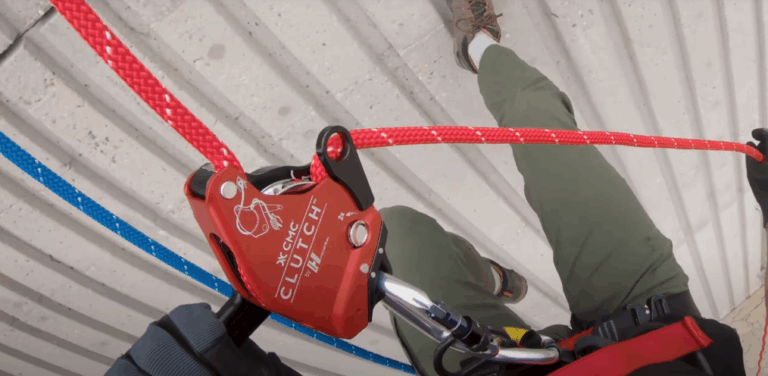
Modern rope rescue now offers mechanical solutions that enhance efficiency while preserving safety. Devices like the CMC CLUTCH and MPD (Multi-Purpose Device) are engineered to provide automatic locking, smooth rope control, and quick transitions between functions—all with minimal physical demand.
CLUTCH
-
Automatic Locking: Engages immediately when the handle is released.
-
Precision Control: Allows fine-tuned lowering and belaying.
-
Multi-Use Tool: Suitable for descent, haul, and belay roles in complex systems.
MPD
-
Built-In Pulley: Enhances hauling efficiency and reduces friction loss.
-
Fail-Safe Design: Locks under load without requiring hand intervention.
-
Versatility: Supports both single and twin rope configurations.
Why Choose Mechanical Belay Systems?
-
Efficiency: Simplifies the rigging and transition process.
-
Lower Physical Load: Reduces fatigue on the belayer in long or complex scenarios.
-
Fail-Safe Functionality: Redundant, automatic braking features increase overall system safety.
Considerations:
-
These devices require formal training to operate safely and effectively.
-
Regular inspection and cleaning are essential for long-term performance.
The Role of a Safety Line in Rappelling
In addition to independent belay systems, incorporating a safety line provides another critical layer of protection for rappelling operations. This parallel rope, independently anchored from the main rappel line, acts as a passive or active backup in the event of primary system failure or loss of control. Safety lines are commonly used in both technical rescue and rope access to enhance redundancy, especially in high-risk environments.
Why Use a Safety Line?
The safety line is designed to:
-
Catch the load if the primary rappel line fails or is severed.
-
Arrest a fall if the rappeller loses control of their descent.
-
Enhance system security in unstable or exposed conditions where operational risk is elevated.
Common Safety Line Configurations
Manual Belay of Safety Line
This approach involves a dedicated belayer managing the safety line from a fixed, secure position.
-
Pros: Real-time adjustments; immediate intervention possible.
-
Cons: Demands a skilled belayer and can be physically taxing on long or complex descents.
Automatic Belay with Mechanical Devices
Devices like the CLUTCH or MPD can be used to manage the safety line hands-free. These devices lock automatically if the rope suddenly accelerates, functioning as an auto-engaging backup.
-
Pros: Reduces human error; consistent performance; minimal hands-on management.
-
Cons: Requires proper setup and user training; device-specific compatibility considerations.
Fixed Safety Line with Prusik Backup
A Prusik loop can be rigged on a fixed safety line to engage automatically if the rappeller descends too quickly or loses control.
-
Pros: Simple, effective, and fully passive.
-
Cons: Sensitive to rope diameter and Prusik tensioning; can engage prematurely if not carefully set.
Setup and Best Practices
-
Use Separate Anchors: Ensure the safety line is completely independent from the rappel line.
-
Check Rope Compatibility: Match device and rope specifications to prevent malfunction.
-
Inspect All Systems: Confirm that anchors, knots, and belay devices are correctly installed and secure.
-
Maintain Clear Communication: Synchronize between rappeller and belayer to avoid miscommunication or unintended movement.
Final Thoughts
Incorporating a safety line into your rappel system is not just a precaution—it’s a standard of care. Whether managed manually, through mechanical devices, or with passive friction hitches, the safety line provides critical redundancy. For rescue teams operating in unforgiving environments, the combination of independent belay systems and dedicated safety lines forms the backbone of a secure and professional descent strategy.
Peace on your Days
Lance