
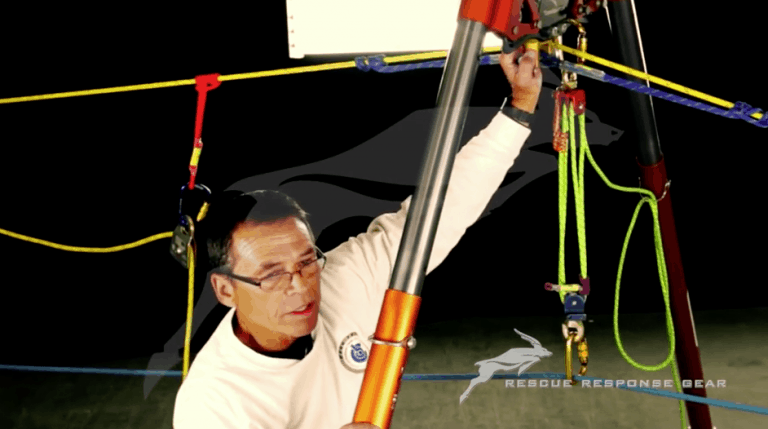
Highline Systems: Advanced Techniques for High-Angle Technical Rescue
Highline operations represent some of the most advanced, demanding, and high-risk rigging scenarios in technical rescue. These systems require an intricate understanding of rigging principles, advanced technician skills, and precise execution. Here’s an in-depth look at the principles, techniques, and considerations for constructing and operating highline systems.
The Role of Highline Systems in Rescue Operations
Highlines are often considered a last-resort option, typically deployed when traditional systems, such as helicopters or mainline/belay line systems, are not feasible. These systems are essential for negotiating expansive gaps or swiftwater scenarios where direct access is impossible. However, the complexity and risks associated with highlines demand rigorous preparation and expertise.
Key Considerations for Highline Systems
Highlines introduce unique challenges that amplify the need for precision and stability. Key principles include:
- Bombproof Anchors: Given the extreme forces involved, anchors must be exceptionally strong and secure.
- Knots and Bends: Minimize or eliminate knots in the trackline to maintain strength and reduce stress points.
- Control Lines: Utilize a pulley tension system with safety mechanisms like system prusiks to manage tension effectively.
- Carriage Systems: Ensure smooth and secure transport of the load across the span.
- Force Management: Avoid over-tensioning, which can exponentially increase vector forces on anchors.
Stages of Highline Operations
Highline construction involves five critical stages:
- Spanning the Gap: Deploying a pilot line, messenger cord, and eventually the trackline across the expanse.
- Constructing High Directionals: Setting up natural or artificial anchors like “A” frames or trees to guide the system.
- Tensioning the Trackline: Pre-tensioning with a 3:1 MA system while avoiding over-tensioning.
- Building Tagline/Belay Systems: Incorporating redundant safety systems to protect the load.
- Carriage Construction and Operation: Using pulleys and tension systems to facilitate load movement.
Advanced Techniques: Multiple Bundles and Floating A-Frames
In situations requiring minimal sag, such as swiftwater rescues, deploying multiple highlines (bundles) can reduce deflection without significantly increasing tension on individual ropes. Similarly, floating “A” frames serve as versatile high directionals when natural options are unavailable, simplifying edge transitions.
Critical Safety Considerations
Highline systems are only as safe as their weakest component. Following these guidelines ensures maximum stability and safety:
- Pre-tension the system cautiously, allowing for at least 10% sag to manage forces effectively.
- Incorporate redundant elements like tandem prusiks at ratchet pulleys for added security.
- Conduct thorough inspections to ensure all knots, anchor points, and systems pass the “whistle test” and “critical point test.”
The Highline Equation
The physics of highlines demands careful force calculations. As vector angles increase beyond 150 degrees, the forces on anchors can multiply from 2x to as much as 11x the load weight. Proper training, planning, and equipment selection are critical to counteracting these immense stresses.
Gear Recommendations for Highline Operations
- Trackline and Tagline Ropes: High-strength, abrasion-resistant ropes like ½-inch static lines.
- Pulley Systems: High-efficiency pulleys for smooth operation and reduced friction.
- Anchors: Bombproof natural anchors or adjustable artificial high directionals like A-frames.
- Tensioning Systems: 3:1 or higher mechanical advantage systems with progress capture devices.
- Carriage Systems: Custom-built or modular solutions for secure load transport.
Training and Preparation
Attempting highline operations without advanced training and experience is strongly discouraged. Accredited training programs provide the necessary skills to handle these complex rescues safely and effectively. Rigging Lab Academy offers a wealth of resources and training to help technicians master highline operations and other advanced rescue techniques.
Explore More:
For comprehensive training and expert insights into highline operations, visit Rigging Lab Academy.
Peace on your Days,
Lance







Comments are closed.