When performing a limb walk, an arborist ideally seeks a straight shot between their anchor and their work position. This is done to avoid the extra friction that is built up by the rope running over other limbs. But this creates a dangerous problem: if the climber falls, there’s nothing to break their fall, which could lead to a long, uncontrolled swing. This is the heart of The Redirect Dilemma Choosing a Safer Path. A redirect is the solution to this problem, but it introduces a new set of complex risks that must be understood to climb safely.
There are some ways to fix the problem of the uncontrolled fall, and the most common method is to establish a redirect. There are two main methods of doing this, each with its own advantages and disadvantages. While a redirect can prevent a dangerous swing, it can also create new issues with friction, compression, and the unknown rating of a tree limb. A skilled arborist must weigh these trade-offs carefully.
The Two Methods of Redirects
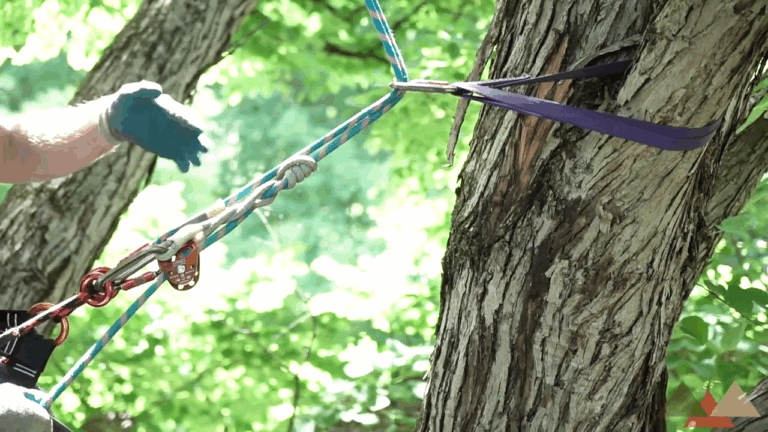
When a climber needs to establish a redirect, they have a few options. The first method is to use a natural redirect. This is a simple, straightforward approach where a climber physically takes their entire rope system and reroutes it over a strong, natural limb. As you can imagine, this creates an immediate point of friction. The rope now runs over not one, but two or more limbs, creating immense friction that can be very uncomfortable. While this method can work in a pinch, it’s not efficient and can make even a simple maneuver a struggle.
A second and more standard method is to use a webbing sling or similar hardware. This is a common practice in the industry. The webbing sling is placed around a strong limb, and the climber’s rope is then attached to it. While a webbing sling can reduce some of the friction associated with a natural redirect, it does not eliminate it entirely. In this case, the friction is now concentrated at a single point, but it’s still there, and it still affects the system’s performance.
The Hidden Dangers of a Redirect
While a redirect can be a crucial safety tool, its use introduces a number of significant hidden dangers. The first and most important is the unrated anchor. As an arborist, you have absolutely no idea as to the rated anchor of that redirect. Unlike a piece of climbing hardware that has a certified strength rating, a tree limb is a living structure. A lot of your decision-making will be based on your knowledge of the species of the tree, its biology, and its structure. It’s an educated guess, not a guarantee. To mitigate this risk, arborists should place the redirect nice and low, onto the base of the limb where it’s at the strongest attachment point. A basket hitch on a webbing sling provides the strongest connection for this particular type of lanyard.
Another major issue is compression. When you put weight on your redirect, your climbing system is drawing and causing compression in the tree. This is a crucial point of tree biology. Limbs are very, very strong in a downward motion—that’s what they’re designed for. But they are nowhere near as strong in an upward motion. As you put pressure on a redirect, you are actually causing compression between the redirect limb and your anchor point, trying to draw them together. This upward pressure can create a bigger weakness than if you had not had the redirect at all.
Finally, you still have the problem of friction and angles. While a redirect can prevent a dangerous swing, you are still on a running or dynamic system. Friction is still being built up, making your rope less efficient. Furthermore, the angles involved here can be creating significant forces on a limb that you have no idea is rated for such stress.
The Path Forward: Balancing Risk and Reward
The redirect dilemma highlights the complex safety trade-offs in arboriculture. A straight, frictionless limb walk is dangerous because of the risk of a fall and swing. A redirected limb walk is a necessary safety measure, but it introduces new risks from compression, friction, and an unrated anchor. The climber must create some slack to get everything attached, and then they have to put their full trust in a system that is creating significant, and potentially damaging, forces on the tree.
Where a redirect is necessary to prevent a big swing, a skilled arborist knows to use their knowledge to mitigate the risks. They will choose the strongest possible anchor points and use the most secure hitches. However, the best solution may be to adopt a system that is designed to avoid this dilemma altogether. Modern climbing systems are built to allow for redirects that eliminate friction and upward forces, giving the climber the ability to manage a swing without introducing new risks.
The classic redirect is a testament to an arborist’s resourcefulness. But by understanding its inherent flaws, climbers can make more informed decisions about when to use it and when to seek out a more advanced solution.
What do you think is the most important factor to consider when choosing a redirect point in a tree?
Peace on your Days
Lance