In the world of professional arboriculture, a limb walk is a fundamental skill. It’s a calculated move that requires a perfect balance of skill, precision, and risk management. This is the essence of The Limb Walking Dilemma: Friction vs. Fall. As a technician moves throughout the tree on a double rope system, their rope is always running, and when it comes in contact with another limb or the trunk, it creates friction. This friction can cause damage to both the rope and the tree itself. To avoid this, an arborist will often seek a clean, high anchor point, but this decision opens them up to a new set of serious risks that must be understood and respected.
While avoiding friction seems like a smart and simple solution, it creates a dangerous trade-off. The pursuit of a perfectly clean angle can put a climber in a situation where a simple slip or misstep could lead to a sudden and uncontrolled fall. This is the central conflict of the limb walk, a maneuver that demands constant vigilance and a clear understanding of the forces at play.
The Perils of Friction
Friction is the silent enemy of the arborist. On a double rope system, it is an unavoidable part of the process. As the rope glides through the anchor point and runs against other limbs, it causes wear and tear. This constant rubbing can damage the rope, compromising its integrity over time. It can also cause damage to the tree’s bark, leaving behind a glazed or worn surface. This is a problem for two key reasons: it affects the longevity of your gear and it goes against the arborist’s primary goal of maintaining tree health.
To minimize this damage and maintain a smooth, efficient system, a climber will naturally try to keep their ropes from making contact with limbs or the trunk. This is a responsible and necessary practice. The more a climber maneuvers through the tree, the more they must actively seek a path for their rope that is as clear as possible. This goal is especially critical when it comes time to perform a limb walk, a task that requires a long horizontal movement away from the main trunk.
The Clean Angle: A Necessary Risk
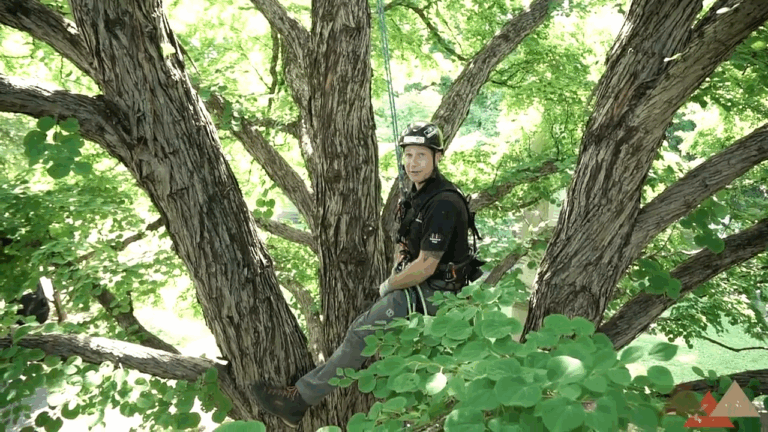
To perform a limb walk effectively and avoid friction, an arborist will ideally use a high anchor point. They’ll make sure there are no limbs in the way, so they can get a nice clean angle to work all the way out on that limb. The goal is to reach a workstation at the far end of the branch. This is the optimal scenario for efficiency, as the rope glides smoothly without drag, and the climber can move quickly to their work area.
This clean-angle approach is a testament to the arborist’s skill and foresight. It shows a knowledge of rope dynamics and a desire to work in the most efficient way possible. However, the very thing that makes this maneuver so efficient—the lack of friction—is also its biggest danger. The clean angle comes at a price, and that price is the absence of any force that can slow or stop a fall.
The Unseen Dangers of the Fall
The problem with this clean-angle approach is that as you are working your way out on that limb, there is nothing that can break your fall. If you were to slip, you would not be stopped by another limb. A simple misstep could put you in a situation where you are free-falling until your rope becomes taut. This sudden stop would cause an immediate and dangerous shock load on your anchor.
This is a grave concern because, as arborists, we have no idea of the actual rating of the limb we are anchored to. That limb is a live, organic structure, not a certified piece of hardware. Shock loading an unrated anchor with the full force of a fall is a major risk that every arborist must avoid.
Even more dangerous is the potential for a pendulum swing. If you fall from the end of a limb with a clean angle, you won’t fall straight down. You will swing. This swing can be sudden and powerful, creating a significant risk of swinging into an obstacle. A climber could swing into the main trunk of the tree, another large limb, or even a building, creating a major hazard that could potentially cause a severe head injury or other serious trauma. The very thing you did to avoid friction—the clean angle—is now a source of significant new risk.
Navigating the Dilemma
The classic limb walk on a double rope system highlights a core conflict in arborist work: the trade-off between efficiency and safety. The more you try to make your rope run smoothly to be more efficient, the more you expose yourself to the risks of a free fall, shock loading, and a dangerous pendulum swing. The double rope system is a valuable tool, but its design forces the climber into a series of difficult choices.
This is why modern climbing systems are so important. They are designed to address this very problem. Newer systems allow for redirects that eliminate friction but still provide a “brake” against a swing, allowing a climber to maintain their horizontal position on a limb without risking a fall and pendulum swing. They are the solution to the high-wire act, allowing the arborist to work with both efficiency and safety.
The classic limb walk is a testament to an arborist’s skill, but it is also a powerful lesson in the importance of understanding and mitigating risk. The best climbers are those who not only know how to perform a maneuver but also understand its inherent dangers.
What techniques have you found most effective for managing the risks of limb walking?
Peace on your Days
Lance