Scenario Analysis for Operational Rigging Decisions
You have a scenario. Not a question with a clean answer and not a system waiting to be verified — a situation with variables, constraints, and consequences that don’t resolve neatly on paper. The environment is a factor. The anchors are what they are. The load is moving in a specific direction through a specific space. And somewhere in the intersection of all of it, a decision has to be made.
Scenario analysis isn’t about finding the right answer. It’s about reasoning through all of them — and understanding what each decision path actually leads to.
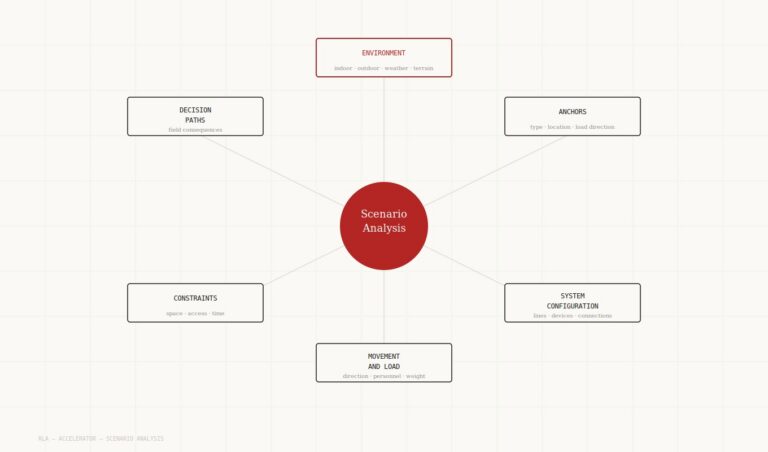
This is where operational rigging gets genuinely complex. A high-angle rescue system looks different indoors versus outdoors, in good weather versus bad, on stable terrain versus compromised. Anchor decisions change when load direction shifts. System configuration choices compound. What seems like a minor constraint — space limitation, time pressure, access issue — can eliminate options that looked viable on paper.
Students encounter scenarios in training and need to reason through them without always having an instructor in the room. Field technicians encounter them on site and need to think through consequences before committing. Both groups benefit from a system that can hold the variables, work through the decision paths, and surface the likely field consequences of each choice.
“The scenario is the thing. Everything else is how you reason through it.”
Consider the moment a technician or student opens a tool and sees a simple prompt: Select one of the Quick Start options below, or enter your system configuration and constraints to begin analysis.
Five options. One of them is built for exactly this kind of complexity.
The moment of entry
The screen offers a choice without demanding credentials first.
Rigging Guidance
Technical Rescue Questions
Scenario Analysis
Systems Check
One tap. Scenario Analysis. The mode activates and asks for what it needs.
What follows isn’t a checklist or a knowledge base lookup. It’s operational reasoning — the system works through decision paths and likely field consequences based on the specific variables you hand it. The more detail you provide, the more precise the analysis.
What the system needs to begin
To begin analysis, I need:
Common scenario types
Six inputs. Plain language accepted. A rough outline or a full technical description — the system will work with what you give it and reason through the operational implications from there. Decision paths identified. Field consequences surfaced. The analysis grounded in the same curriculum that underpins the courses and content the RLA knowledge base is built on.
That grounding matters more in scenario analysis than anywhere else. Because a scenario isn’t hypothetical — it represents a real decision about a real system in a real environment. The reasoning behind it should come from the same place as the training.
Scenarios don’t wait for the right moment. They arrive with the variables they arrive with and require a decision. Having a system that can reason through those variables — that understands decision paths and field consequences, not just configurations — changes what’s possible in the moments that matter.
Sometimes the step is just choosing Scenario Analysis. And finding out that the reasoning you needed was already within reach.
That’s what it feels like when operational complexity has somewhere to go. Not simplified. Not reduced. Just worked through — carefully, with the full weight of the discipline behind it.
Peace on your Days
Lance