A climber’s work is a delicate balance of skill, science, and trust in their gear. That trust often starts with the ropes that support them. While both rope access technicians and arborists use a dual-rope system, their approaches are fundamentally different. This is the essence of Primary vs Backup The Difference in Dual-Rope Systems. In a standard rope access setup, a technician accesses a site using one primary line for ascent and descent. A second line is dedicated solely as a backup. In contrast, arborists have developed a system that uses twin primary systems, a distinction with a huge impact on safety and a climber’s ability to rescue themselves.
Both systems have a very proven safety record. The core idea is simple: limit any potential fall. As a result of this design, rope access technicians can limit a fall to less than two feet. Arborists, however, take this a step further. They change the dynamic of the two ropes, turning a backup system into a second primary system.
The Standard Rope Access System
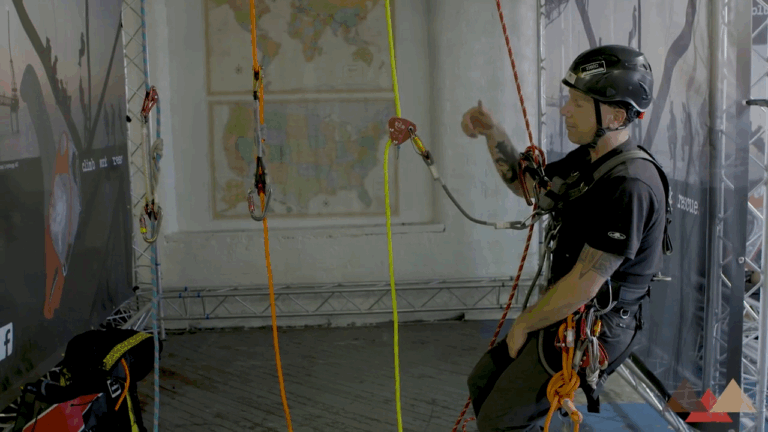
A standard rope access setup requires a technician to access their work environment with two ropes. Crucially, both ropes are anchored to known, rated anchors. This is a major advantage. The technician knows exactly how strong their connection points are. The primary rope handles ascent and descent. Meanwhile, the second rope functions as a backup system in case the primary were to fail.
To ascend, a technician uses a chest ascender and a hand ascender on the primary line. As they climb, a backup device on the backup line automatically moves with them. This device is designed to catch any potential fall within two feet. In addition, when descending, the technician uses a mechanical device with a known rating for both one- and two-person loads. They control the descent by engaging the device’s handle and working the trailing end of the rope with their other hand. As they descend, their backup device also moves with them, ready to catch them if the primary system fails.
Still, the main drawback is what happens if the primary system does fail. If the technician hangs on their backup, their ability to self-rescue is limited. They need another way to get off of the backup line. While a self-rescue might be possible, a pickoff rescue from another technician is often the predominant method.
The Arborist’s Advantage Twin Primary Systems
The arborist’s two-rope system is an evolution of this proven method. Instead of having a primary and a backup, an arborist uses two primary systems. This is a critical distinction that changes the entire approach to climbing safety and rescue.
This system gives an arborist several key advantages. First, they can work just like a rope access technician, always having a second line for backup. Consequently, as they ascend and descend, they are always backed up by a second primary system. This means that if anything were to happen to either one of their systems, the other would be fully capable of holding them.
Because an arborist has two primary systems, a self-rescue is extremely easy. For instance, if one system were compromised, the climber could simply transfer their weight to the other primary system and either fix the issue or descend. This gives them the ability to always remain in a static setup. You can effectively limit any potential fall to even less than two feet. It eliminates the need for a secondary rescue and gives the climber total control over their safety.
A Proven Record and an Evolving Standard
Rope access technicians have a very proven safety record. They have shown that by using two ropes and limiting a fall to less than two feet, they can nearly eliminate the risk of a major fall during their work. Their systems are highly efficient for ascent and descent. Furthermore, they build their systems on the foundation of known, rated anchors.
The arborist’s system takes the concept of dual-rope climbing and applies it to a dynamic, natural environment where anchors are unrated. By using two primary systems, arborists have built a safer, more versatile setup that improves upon a proven safety record. The arborist’s twin primary system offers the added benefit of a superior ability for self-rescue. It empowers the climber to remain in control even in the event of a system failure. This is not just a different way to climb; it’s a testament to the continuous evolution of safety standards in the industry.
What do you think is the biggest trade-off between the rope access system and the arborist’s twin primary system?
Peace on your Days
Lance