
Bombproof Anchors in Rigging: A Comprehensive Guide
When it comes to rescue and rigging operations, anchors are the cornerstone of a successful and safe system. Among these, bombproof anchors stand out as the gold standard, particularly when paired with artificial high directionals like the Arizona Vortex Multipod. However, understanding what makes an anchor truly “bombproof” can be a source of confusion for many riggers and rescuers. Let’s break it down.
What Defines a Bombproof Anchor?
A bombproof anchor exhibits two essential characteristics:
- Structural Integration:
The anchor point is so seamlessly integrated into the environment that its failure would compromise the entire structure. Think of a mountain or a deeply rooted tree—failure would require catastrophic conditions that would also destroy the surrounding area. - Immovable Points:
The anchor is so large and secure that any movement is inconceivable. Whether it’s a massive boulder or a fixed steel I-beam in an industrial setting, these anchors are reliable beyond question.
Evaluating Bombproof Anchors
Understanding whether an anchor is bombproof comes with experience. For novice riggers, erring on the side of caution with redundancy is a wise approach. However, experienced professionals can assess the context and forces at play to determine the reliability of an anchor without overengineering.
- Urban and Industrial Anchors:
Anchors like I-beams and structural columns are typically considered bombproof due to their design and intended load-bearing capacity. - Natural Anchors:
Well-rooted trees, large boulders, and solid rock outcroppings are prime examples. However, situational awareness is key. A boulder on loose sand might be unreliable for one application but ideal as a directional anchor.
Dealing with Questionable or Marginal Anchors
If an anchor doesn’t meet the criteria for bombproof reliability, it is classified as questionable or marginal. These anchors require:
- Backups:
Add independent anchor points to create a load-sharing system that ensures redundancy. - Reinforcement:
Marginal anchors often need multiple points to distribute the load effectively and maintain stability.
Artificial High Directionals and Bombproof Anchors
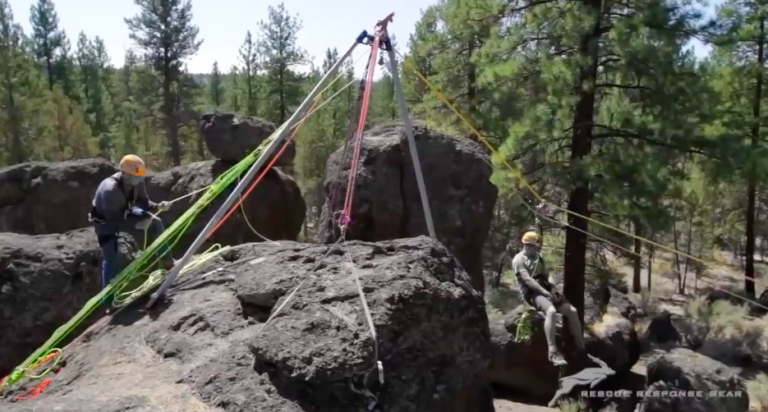
Using artificial high directionals (AHDs) like the Arizona Vortex can simplify complex rigging scenarios. The Arizona Vortex is NFPA G-rated, making it bombproof when used correctly. However, the true test of reliability lies in back-ties or guying systems, which manage the resultant forces.
Resultants must be carefully calculated and managed to ensure stability. Properly tensioned back-ties counteract these forces, turning the Vortex into an indispensable bombproof anchor for high-angle rescues and complex rigging.
Final Thoughts
Whether you’re building anchors in an urban, industrial, or wilderness setting, the principles of bombproofing remain the same: understand the forces, evaluate the anchor’s reliability, and reinforce where necessary. While artificial high directionals like the Arizona Vortex simplify many aspects of rigging, it is your skill and judgment as a rigger that ultimately determine the success of the operation.
If you’re passionate about mastering anchor systems and want to take your skills further, explore the Twin Tension Rope Systems and Artificial High Directional Series at Rigging Lab Academy.
Peace on your days
Lance



Comments are closed.