In rope rescue, particularly in vertical environments, the system doesn’t start with a rope—it starts with the anchor. Anchoring systems carry more than just load; they define access pathways, movement potential, and, most importantly, your margin for error. Every descent, raise, or track line depends entirely on what you’ve built at the base: your foundation.
A high line or a vertical lower system is only as stable as what supports it. And while that support might come from steel structures, exposed rock, engineered bolts, or even artificial high directionals (AHDs), the principle remains unchanged: equalize, isolate, and control the vector. Anchoring isn’t just about “holding”; it’s about shaping the system around known forces and unknown conditions.
Anchoring Is an Active Choice
One of the most common misunderstandings in rescue training is thinking of anchors as static or passive components—just something to “clip into” before the work begins. In truth, anchoring is one of the most active decisions a rescue technician will make. It sets every other system into motion.
When terrain offers no second chances—cliffs, towers, or industrial platforms—an anchor can either expand your options or limit your control. The decision to select and build an anchor is more than a checklist step; it is a moment of intentional rigging judgment.
A few guiding questions illustrate this well:
- Have we accounted for direction of pull and anticipated vector changes?
- Are we distributing the load or relying on a single point?
- What happens if the primary fails—do we have functional redundancy?
- Is this anchor supporting movement, or just resisting it?
Every one of these questions ties back to equalization, isolation, and vector control.
Equalization, Isolation, and Vector Control
These three principles—far from buzzwords—are what give anchor systems their real-world viability.
Equalization is about ensuring that multiple anchor points share the load effectively. Whether using load-distributing or pre-equalized configurations, the goal is to prevent overloading one leg of the system while accounting for movement and load shifts. Equalization allows the anchor system to behave predictably even under tension.
Isolation ensures that individual anchor components can fail without compromising the system. If your backup anchor shares a master point with the primary, it’s not truly isolated. Strong anchors isolate failure, giving the system time and resilience when something doesn’t go as planned.
Vector control refers to how the force travels through the system. Poor vector control leads to side loading, gear inefficiency, and unpredictable system behavior. Good riggers don’t just look at where the rope runs—they understand how energy moves through the setup. That understanding starts at the anchor.
Foundation Drives Function
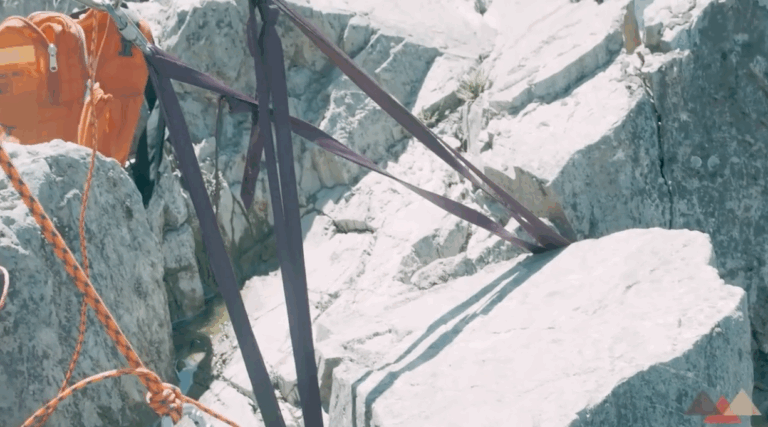
In the video accompanying this topic, you’ll see the idea play out in real time: selecting the right anchor system isn’t about convenience. It’s about mission. Whether using steel towers, rock outcrops, or artificial directional devices, the rigging team evaluates not just where they can build—but why they should build there.
Anchoring becomes a form of strategic thinking:
- In an urban industrial environment, a fixed steel beam might be the most reliable choice, but does it allow for optimal rope path and load redirection?
- On a wilderness cliff face, the best natural anchor may need reinforcement—are you combining marginal anchors into a single shared-load system?
- In a high line scenario, does your anchor allow for lateral movement and tension tracking across a span?
Each scenario reaffirms the truth: anchoring isn’t separate from the system—it is the system.
Conclusion
Anchors are not passive hardware. They’re the starting point of judgment, the controller of force, and the container of chaos. In vertical environments, where small miscalculations ripple into massive consequences, anchoring defines whether the system holds or fails. Whether your foundation is steel, granite, or tripods on uneven ground, the same mindset applies—equalize the load, isolate the system, and control the vector.
This isn’t just about technical compliance. It’s about command presence in the rigging world. Make your anchor count.
Peace on your Day
Lance