Climbers who are comfortable with a doubled rope system often find the transition to a single rope work positioning system both exciting and intimidating. At first glance, the two approaches appear similar. Both use a friction hitch or device, both allow upward and downward movement on the rope, and both can be used for safe work positioning. However, the mechanics of a single rope work positioning system — also called a stationary rope system or single rope technique — are very different.
When used properly, this method opens up new efficiency, smoother movement, and better work positioning. Yet it also comes with a psychological adjustment: instead of seeing two rope legs sharing your weight, you now see just one line holding you. For many, this takes time to trust.
This article explains what single rope work positioning systems are, why they differ from doubled rope systems, the common challenges climbers face, and how to overcome them through correct equipment and ascent methods.
What Is a Single Rope Work Positioning System?
A single rope work positioning system (SRS) involves anchoring a rope at one end and climbing directly on that single, stationary line. Unlike doubled rope systems, where the rope travels through a pulley effect and returns to the climber, in SRS the rope does not move at the anchor.
Key points:
-
The rope is stationary at the top.
-
Friction is managed entirely at the hitch or mechanical device.
-
Progress is made by advancing the hitch or device up the rope.
-
Efficiency comes from leg-driven ascents instead of rope hauling with the arms.
This means the climber climbs on the rope, not with the rope. It requires new movement patterns and equipment adjustments.
The Psychological Challenge of Seeing One Rope
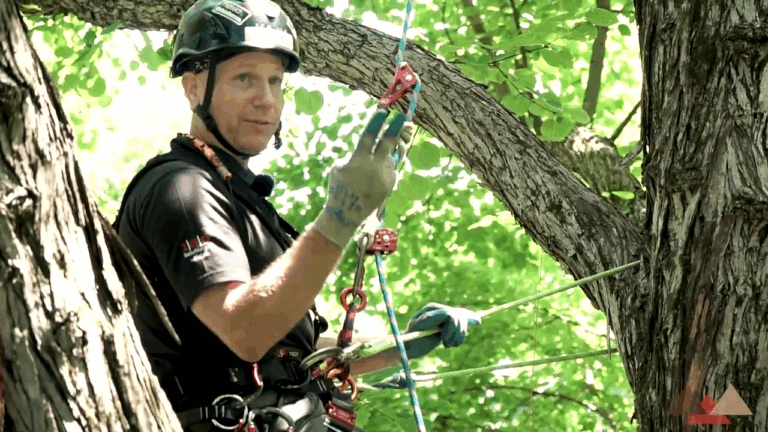
For years, arborists and rope workers have climbed doubled rope systems. Even though it is technically one rope folded in half, climbers see two strands and instinctively feel secure. Switching to a single rope, especially when hanging on a limb and looking back to see only one line, can feel unnerving.
This reaction is common. Climbers often feel as though one rope is weaker than two, even though system strength is not compromised when equipment is configured correctly. Over time, training and repeated exposure eliminate this hesitation.
The solution is confidence through practice:
-
Understand how the load is distributed.
-
Trust the tested hitch or device.
-
Train in short climbs until the system feels normal.
Differences Between Doubled Rope and Single Rope Systems
Although the rope and hitch may look the same, there are fundamental differences between doubled rope and single rope systems.
Doubled Rope System
-
Rope moves with the climber.
-
Built-in 2:1 mechanical advantage when pulling down on the rope.
-
Perceived redundancy with two visible rope legs.
-
Familiar for most arborists.
Single Rope System
-
Rope is anchored at one end and remains stationary.
-
No mechanical advantage; the climber moves directly against bodyweight.
-
More efficient with proper technique, less efficient with improper technique.
-
Requires specialized ascent methods to be smooth and safe.
Three Essential Elements for SRS Efficiency
1. Overcoming the Psychological Shift
The most important first step is trusting the system. Climbers must learn to feel secure on one rope. Recognize that all life-support equipment is tested for single rope loading. The rope is no weaker simply because it is used differently.
2. Efficient Ascent Methods
Unlike doubled rope, you cannot pull yourself up by hauling rope down. On SRS, ascents must use mechanical advantage devices like foot ascenders, knee ascenders, or walking systems. Leg-driven methods are the foundation of efficiency.
3. Hitch and Device Management
Because the rope is stationary, the hitch or device must be tuned carefully to grip when weighted and advance smoothly when unweighted. Many climbers add a tending connection to help the hitch rise automatically.
Ascent Options on Single Rope Systems
Foot Ascender
The simplest and most effective first step is adding a foot ascender. This small cam device attached to the rope allows the climber to step upward and advance the hitch automatically. Compared to foot-locking, the foot ascender is far more efficient.
Knee Ascender (HAAS-Style)
Adding a knee ascender with a foot loop on the opposite leg creates a balanced, stair-like motion. Each step advances the rope system without needing hands to tend the hitch. This is especially useful when climbing through limbs.
Sternal Attachment
Connecting the chest to the tether’s base allows the hitch to rise automatically with each step. This keeps both hands free for balance and stability.
Walking Systems
Some climbers add handled ascenders and foot loops to create a full walking system. These allow nearly hands-free ascents, though they require more gear.
Advantages of Single Rope Work Positioning
-
Efficiency: Leg-driven climbing is less tiring and more sustainable.
-
Precision: The stationary rope makes work positioning extremely accurate.
-
Versatility: Redirects and alternate anchor options expand what you can do in the canopy.
-
Safety: When configured correctly, the system is as strong and reliable as doubled rope.
Safety Considerations
-
Always maintain two points of attachment when changing or adjusting equipment.
-
Test the hitch before committing your weight.
-
Keep backups (lanyard, secondary ascender) in place until new configurations are secure.
-
Inspect gear frequently; stationary systems place friction in concentrated areas.
Training Recommendations
-
Begin in controlled environments and short climbs.
-
Use a foot ascender as your first upgrade — the efficiency gain is immediate.
-
Gradually add knee or sternal attachments once the base system feels natural.
-
Practice redirects and descent techniques until they are smooth and repeatable.
Conclusion
The single rope work positioning system is not just a variation of doubled rope climbing; it is a fundamentally different way of moving on the rope. At first, the sight of one rope may feel uncomfortable, but practice and confidence replace hesitation with efficiency.
By understanding the psychological adjustment, adopting leg-driven ascent methods, and managing your hitch or device properly, climbers unlock the true advantages of stationary rope systems: efficiency, safety, and versatility. With training, SRS will not only match what you can do on doubled rope — it will surpass it.