Anchors Are the Foundation of Every System
In rope rescue, every system begins—and ultimately depends—on the anchor. Whether you are lowering, raising, or managing a directional line, the integrity of the entire operation is tied to how well the anchor system is built. A failure at the anchor is not a component failure—it is a system failure.
In ideal conditions, a single bombproof anchor may be available. But field reality rarely provides perfect options. Trees may be undersized, structural elements may be poorly positioned, and natural features may lack the strength required for a full operational load. In these cases, the solution is not to accept compromise—it is to build strength through combination.
This is where the 3-point anchor system becomes essential. By integrating three independent anchor points into a single, cohesive system, the load can be shared, risk can be distributed, and stability can be maintained under operational stress.
Understanding the 3-Point Load-Sharing System
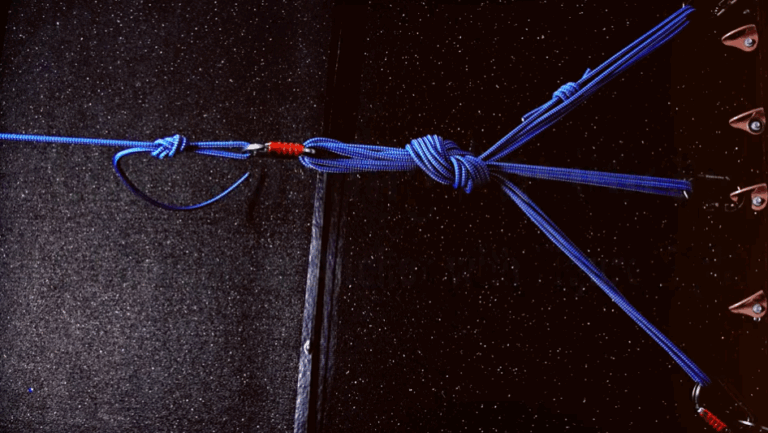
A 3-point anchor is a load-sharing anchor system (LSA) built by connecting three independent anchor points to a central master point. Unlike dynamic systems that adjust under load, this configuration is fixed. Once constructed, the way force is distributed across the anchors is determined entirely by the geometry of the system.
This distinction is critical. A load-sharing system does not self-correct. It does not slide or rebalance as the load shifts. Instead, it behaves exactly as it was built—making precision in setup non-negotiable.
The strength of the system comes from three primary characteristics:
- The load is distributed across multiple anchors
- Redundancy ensures no single point of failure
- Fixed construction prevents extension and shock loading
These properties make the 3-point anchor one of the most reliable and widely used configurations in technical rescue.
How Load Is Managed Across Three Points
At its core, the purpose of a 3-point anchor is to ensure that no single anchor carries the entire load. Instead, force is shared between all three points—provided the system is properly equalized.
However, load sharing is not automatic. It is governed by three factors:
- The length of each anchor leg
- The angles between the legs
- The alignment of the master point with the load direction
If one leg is shorter than the others, it will engage first and carry a disproportionate load. If the master point is misaligned, one side of the system will be overloaded while the others remain underutilized. The system will still function—but not as intended.
This is why equalization is not just a concept—it is a construction requirement.
Angle Control and Force Implications
The most overlooked—and most critical—element of a multi-point anchor system is angle management.
As the angle between anchor legs increases, the force applied to each anchor increases as well. What appears to be a balanced system can quickly become overloaded if angles are allowed to open too wide.
Operationally:
- Angles at or below 90° maintain efficient load sharing
- Angles approaching 120° significantly increase force on each anchor
- Angles beyond 120° introduce unacceptable force multiplication
This is not theoretical—it is mechanical reality. Poor angle control does not degrade the system gradually; it accelerates force into the anchors in ways that are often invisible during setup.
Maintaining tight, controlled angles is one of the simplest and most effective ways to preserve system integrity.
Building the 3-Point Anchor System
Constructing a 3-point anchor system is straightforward in principle, but it requires discipline in execution. Each step contributes directly to how the system will behave under load.
First, select three independent anchor points. These must be solid, reliable, and capable of supporting the full system load individually. Redundancy is not created by combining weak anchors—it is created by combining viable ones.
Next, connect each anchor to a central master point using rope, webbing, or slings. Common methods include cordelette systems tied with figure-eight knots or basket hitches that secure each leg independently.
Once connected, establish fixed lengths for each leg. This is what defines the system as load-sharing rather than load-distributing. There should be no sliding components and no capacity for the system to re-equalize under movement.
From there, equalize the system by adjusting each leg so that all three anchors engage simultaneously. This is often done visually and tactically, ensuring that no leg is slack and no single anchor is preloaded.
Finally, position the master point so it aligns directly with the anticipated load direction. This ensures that the system behaves predictably when tension is applied.
System Behavior Under Load
Once the system is loaded, its behavior is fixed. The distribution of force will not change unless the system itself changes.
This predictability is a strength—but it is also a limitation.
Because the system does not self-adjust, any shift in load direction can result in unequal loading. One anchor may take significantly more force than intended, while others contribute less. In static environments, this is not an issue. In dynamic or shifting environments, it becomes a critical consideration.
The takeaway is simple: a 3-point anchor system must be built for the load it will actually see—not the load you assume it will see.
Strengths of the 3-Point Anchor
When constructed correctly, the 3-point anchor system offers a level of reliability that is difficult to match.
It provides true redundancy, ensuring that the failure of a single anchor does not result in total system collapse. Its fixed design prevents extension, eliminating the risk of shock-loading remaining anchors during a failure event. It is clean, efficient, and easy to inspect—qualities that matter in high-stakes environments.
Most importantly, it delivers predictable performance. In rescue operations, predictability is control.
Limitations and Operational Considerations
Despite its strengths, the 3-point anchor system is not universally applicable.
Because it does not adjust dynamically, it is not well suited for situations where the direction of pull is expected to change. In these environments, a load-distributing system may be more appropriate, despite its own tradeoffs.
Additionally, improper setup can undermine the entire system. Unequal leg lengths, wide angles, or poor alignment will result in inefficient load sharing and increased stress on individual anchors.
More anchors do not automatically mean more safety. Without proper geometry, additional anchor points can introduce complexity without improving performance.
Applying Anchor System Principles
The effectiveness of any anchor system—regardless of configuration—can be evaluated using the ERNEST framework:
- Equalized – Load is distributed as evenly as possible
- Redundant – No single point of failure
- Non-Extending – Prevents shock-loading during failure
- Solid – Anchors are reliable and appropriate
- Timely – Built efficiently under operational conditions
The 3-point anchor excels in redundancy and non-extension. Its success in equalization, however, depends entirely on the quality of the build.
Where the 3-Point Anchor Performs Best
This system is most effective in environments where the load direction is known and stable.
It is commonly used in vertical raising and lowering systems, where forces remain consistent and predictable. It is also highly effective in industrial and structural environments, where anchor points are fixed and well-defined.
In marginal environments—where no single anchor is sufficient—it allows multiple moderate anchors to be combined into a system that meets operational demands without compromising safety.
Final Takeaway
A 3-point anchor system is not simply a way to “add more anchors.” It is a method of controlling force, managing risk, and creating stability in environments where certainty is limited.
Its strength lies in its simplicity—but that simplicity demands precision. The system will not correct mistakes. It will only reflect them.
When built correctly, it becomes one of the most dependable anchor configurations in rope rescue. When built poorly, it becomes a false sense of security.
The difference is not in the materials. It is in the understanding.
Peace on your Days
Lance