
Understanding Resultant Forces in Two-Rope Tension Systems
Resultant forces play a critical role in ensuring the stability and efficiency of high directional systems, especially when dealing with two-rope tension setups. This concept is foundational for rescue operations, where precise control of forces determines the safety and functionality of the entire system. Let’s delve deeper into the importance of resultant vectors and their application in A-frame configurations.
What Is a Resultant Vector?
In the context of high directionals, a resultant vector refers to the combined measure of force and direction acting through the head pulleys. This vector ensures the compression forces pull directly downwards, stabilizing the frame or pod. Regardless of the magnitude of force applied, the direction of the resultant vector is key.
For optimal stability, the resultant must land within the footprint of the system. For instance, with a single pulley, the vector line naturally aligns through the center of the pulley, simplifying visualization and force management.

Managing Resultant Movement During Edge Transitions
In dynamic scenarios such as edge transitions, resultants often shift due to changes in rope tension or load movement. For example:
- As an attendant moves back and up, the resultant vector swings forward.
- This can destabilize the frame if not properly counteracted.
To manage these shifts, tensioning systems like a guying system are employed. By dividing tension points equally around the frame—ideally at 120° intervals in a 360° circle—the structure remains secure and compression forces are evenly distributed.
Guying Systems: Techniques for Stability
Three common guying systems are often used in A-frame configurations:
- Petzl Jag System: A simple and efficient system that allows tension adjustments with minimal effort. This setup ensures consistent compression across the frame.
- Voodoo or Transport Hitch: A self-adjusting tensioning system ideal for dynamic adjustments during operations.
- Non-Working 3:1 System: While it cannot be adjusted once set, this system provides frictional stability to anchor points. It’s simple yet effective for static loads.
Resultant Forces in Different Configurations
- Tripods: With a wider footprint, tripods provide a larger area for the resultant vector to land, ensuring greater stability for complex loads.
- Monopods or Gin Poles: These configurations require the resultant to fall closer to the single point of contact to maintain stability.
- A-Frames: As seen in our setup, the resultant should always align within the hobble straps and stay centered between the legs.
Each configuration emphasizes the necessity of managing resultants carefully, as any deviation can compromise the system’s integrity.
Gear Used in This System
To construct and stabilize the A-frame, the following equipment was used:
- CMC Arizona Vortex 2 Multipod: A versatile high directional system for advanced rescue setups.
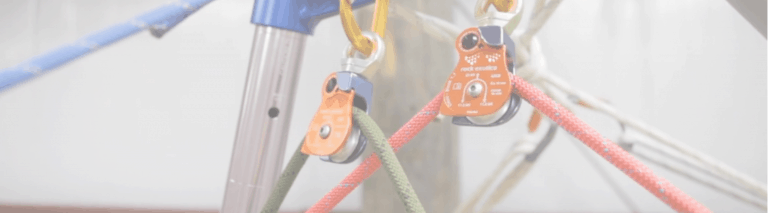
- Rock Exotica Omni-Block 1.1″ Single Pulley: Enhances efficiency by reducing friction.
- Petzl Rollclip and Tibloc Ascender: Reliable tools for load management and rope adjustments.
- Petzl Jag System: Facilitates precise tensioning in guying systems.
- Petzl Axis 11mm Rope: Durable and suitable for heavy loads.
- Petzl Sm’D Carabiner: Secure and lightweight for easy rigging.
Why Understanding Resultants Matters
Properly managing resultant forces ensures:
- Safety: Prevents tipping or structural instability.
- Efficiency: Reduces setup time while maintaining system reliability.
- Adaptability: Supports various configurations, from tripods to monopods.
Final Thoughts
Resultants are a cornerstone of high directional rigging. By understanding and applying these principles, technicians can ensure stable and efficient rescue operations, even in challenging scenarios. Whether you’re transitioning a load over an edge or configuring an A-frame for stability, keeping the resultant within the system’s footprint is the key to success.
Gear & Equipment We’re Using:
- CMC Arizona Vortex 2 Multipod
- Rock Exotica Omni-Block 1.1″ Single
- Petzl Rollclip
- Petzl Tibloc Ascender
- Petzl Jag System
- Petzl Axis 11mm Rope
- Petzl Sm’D Carabiner
Peace on your Days
Lance


Comments are closed.