
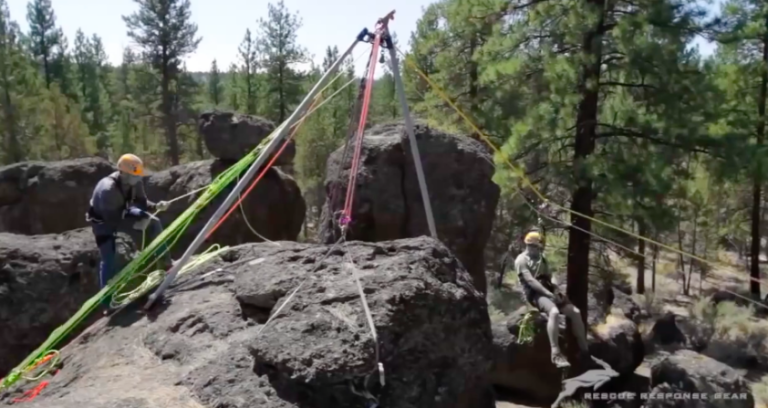
Mechanical Advantage Progression: The Key to Rigging Efficiency
Understanding Mechanical Advantage (MA) in Rigging Systems
Mechanical advantage (MA) is a cornerstone concept in technical rescue and rigging. By leveraging systems of pulleys, ropes, and anchors, rescuers can magnify their pulling force to lift heavy loads or manage difficult terrain. Whether working on a confined space rescue, high-angle rope scenarios, or industrial rigging operations, understanding MA progression is critical for efficiency and safety.
This guide explores the principles, progression, and practical applications of MA systems, while addressing the nuances that make these systems so essential in the field.

What Is Mechanical Advantage?
Mechanical advantage refers to the ratio of force exerted to force applied in a system. In simple terms, it allows a team to lift or move a load with less effort than would otherwise be required. This is achieved by redistributing forces through pulleys, anchors, and ropes.
For example:
- A 2:1 system means that the force required to lift a load is halved.
- A 3:1 system reduces the effort to one-third of the load weight.
Theoretical MA calculates the ideal force multiplication without factoring in friction or inefficiencies, while actual MA considers real-world losses due to rope friction, pulley resistance, and other variables.

The Progression of Mechanical Advantage Systems
Progression in MA systems involves starting with simple setups and building more complex configurations based on operational needs. Here is a breakdown of the typical progression:
1. Simple Systems
Simple MA systems are the foundation of rescue rigging. These systems are straightforward, with all moving pulleys traveling at the same speed and direction as the load.
- 2:1 Simple System: A single movable pulley doubles the force applied.
- 3:1 Z-Rig: The rope configuration resembles a “Z,” increasing efficiency for light to moderate loads.
Key Use Cases:
- Basic lifting operations
- Lowering systems in controlled environments
2. Compound Systems
Compound systems are created by combining two simple systems. They offer higher mechanical advantage and are ideal when greater lifting power is required.
- 4:1 Compound System: Combines two 2:1 systems.
- 6:1 Compound System: Adds a 3:1 system to a 2:1 base.
Key Use Cases:
- Confined space rescues
- Situations requiring heavy load lifting
3. Complex Systems
Complex systems involve configurations where pulleys move at different speeds and directions relative to the load. While harder to set up, they offer unique advantages in specific scenarios.
- 5:1 Complex System: Optimizes efficiency and reduces rope length requirements.
- Highline Systems: Combines tensioned systems with movement across spans.
Key Use Cases:
- Highline operations
- Scenarios requiring precise load control

Calculating Mechanical Advantage
Calculating MA ensures you understand the forces at play and can design safe, efficient systems. One effective method is the T-Method, which works as follows:
- Assign 1 unit of tension (1T) to the haul team.
- Trace tension through the system, doubling tension at pulleys.
- Add tensions at key junctions to determine total MA.
For example, in a 3:1 Z-Rig:
- 1T enters the system.
- 1T doubles at the first pulley to 2T.
- The rope tension combines at the anchor to total 3T.
The result is a 3:1 theoretical mechanical advantage.

Maximizing Efficiency in MA Systems
Efficiency is key to ensuring your MA system operates smoothly. Here are ways to maximize efficiency:
1. Minimize Friction
- Use high-quality pulleys with ball bearings.
- Avoid rope-on-rope friction.
- Use edge protectors to reduce abrasion.
2. Optimize Rope Management
- Keep ropes parallel but untangled.
- Avoid excessive slack to maintain tension.
3. Choose Appropriate Systems
- Use the lowest MA system needed to complete the task.
- Higher MA systems require more resets, reducing efficiency.
Practical Applications of MA Progression
1. Rescue Operations
Rescuers rely on MA systems for lifting casualties, lowering stretchers, or stabilizing loads during evacuations. Compound and complex systems are particularly useful in technical rescues.
2. Industrial Rigging
MA systems play a significant role in construction, where heavy materials need to be moved or lifted. Efficiency and safety are paramount in these operations.
3. Training and Drills
Understanding and practicing MA progression ensures teams are prepared for real-world challenges. Regular training helps improve familiarity with setups and troubleshooting.
Advancing to the Next Level
Mastering MA progression means moving beyond basic setups and learning to adapt systems to specific challenges. Consider advanced techniques like:
- Hybrid Systems: Combine multiple MA types for unique scenarios.
- Dynamic Highlines: Integrate movement across spans with tensioned systems.
- Troubleshooting: Recognize and resolve inefficiencies in the field.
By continually refining your knowledge and skills, you’ll ensure your team operates with maximum effectiveness and safety.
Conclusion
Mechanical advantage progression is a vital component of rescue and rigging work. From simple 2:1 systems to complex highlines, understanding the principles, applications, and calculations behind MA systems enables teams to perform efficiently under pressure.
Invest in training, practice regularly, and explore advanced techniques to build a comprehensive understanding of MA progression. For more in-depth resources, check out the Rigging Lab Academy’s courses and tools—your go-to source for mastering the art and science of mechanical advantage systems.

Peace your Days
Lance




Comments are closed.