
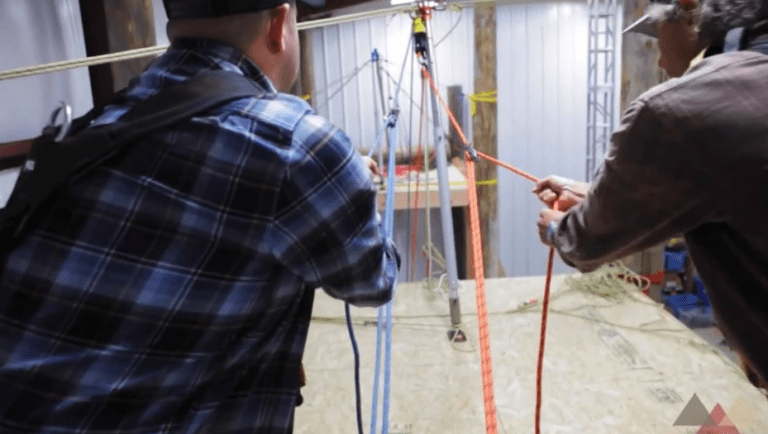
In technical rope rescue, the Two-Rope Offset System, also known as “cross hauling,” is a method that utilizes two tensioned rope systems to maneuver a load horizontally across a gap or away from obstacles. This technique offers a practical alternative to highlines, providing efficiency and safety in various rescue scenarios.
Understanding the Two-Rope Offset System
The Two-Rope Offset System involves two identical tensioned rope systems working in tandem. Each system can function as either a hauling or lowering line, allowing precise control over the load’s position. This setup effectively halves the tension on each side, reducing the risk of load-related issues.
Key Features:
- Load Distribution: Both ropes share the load equally, enhancing system redundancy and safety.
- Directional Control: By adjusting tension on either side, rescuers can move the load laterally, facilitating navigation around obstacles or spanning gaps.
- Simplified Setup: Compared to highlines, the Two-Rope Offset System is quicker to establish and requires less equipment.
For a detailed exploration of this system, refer to the article “Litter Hauling Techniques Using Dual Capacity or Twin Tension Rope Systems Part 3: Via A Two Rope Offset.”
Advantages Over Highline Systems
While both the Two-Rope Offset and highline systems aim to transport loads across spaces, the Two-Rope Offset offers distinct benefits:
- Lower Vector Forces: The system creates deeper “V” angles, resulting in narrower catenary angles and reduced stress on anchors.
- Efficiency: It spans gaps more effectively and simplifies patient transfers, making it well-suited for pickoffs.
- Versatility: The system adapts to various rescue scenarios without the complexity associated with highline setups.
These advantages make the Two-Rope Offset a valuable technique in the rescuer’s toolkit.
Implementation Considerations
When employing the Two-Rope Offset System, consider the following:
- Anchor Integrity: Ensure all anchors are robust and capable of handling dynamic loads.
- Team Coordination: Effective communication is crucial, as one team manages the hauling while the other controls the lowering.
- Equipment Compatibility: Utilize compatible devices, such as the CMC MPD or Petzl I’D, to facilitate smooth transitions between hauling and lowering.
Proper training and practice are essential to master this system and ensure safety during operations.
Conclusion
The Two-Rope Offset System provides a practical and efficient solution for horizontal movement in rescue operations. Its simplicity, combined with the ability to control load positioning precisely, makes it a preferred choice over more complex highline systems in many scenarios.
For further insights and training resources on this and other rescue techniques, visit Rigging Lab Academy.
Offsets include a variety of “methods, set ups or techniques”… and a Two Rope system is one of six. Rigging Lab Academy has courses and tutorial on all of these systems… so check in on any or all of them as they are well worth the time and effort to do so.
- Tagline
- Guiding Line
- Tracking Line
- Skate Block
- Deflected or Dynamic Directional
- Two Rope
Two Rope Offsets should be considered long before determining a highline set up. Offsets could serve as the 90% solution for just about all the “spanning the gap” jobs. Straight up and down rescues (served through two tension systems or not) now have a mirrored technique. The system serves both sides equally and can be mirrored. Artificial or Natural High Directionals are generally needed. Stay with the system you have in place and double it on the other side. Now I understand it isn’t quite that simple, but you get the point right?
So lets do this! We are working on a brand new course and yes… this is a teaser. In the coming weeks you’ll be see more on this unique and monumental “first ever” course.
Peace on your Days…
Lance

Comments are closed.