
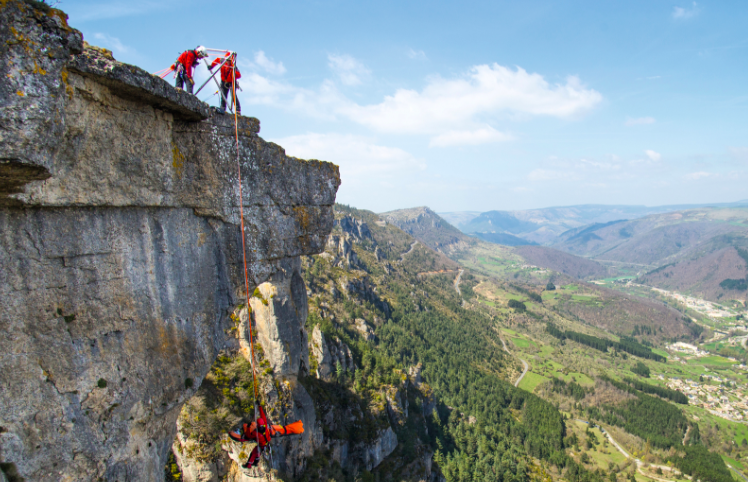
I wanted to talk a bit about a tool (Litter Hauling Techniques) that I know for a fact, not enough people are aware of. The Jag System from Petzl. I happened upon this quick tech tip from Petzl and noticed 4 people in the system. Does it or should it really take 4 people to do a raise/lower system? I suggest no!
Having just come back from St John USVI, our host team (St John Rescue) did in fact have a Jag System in cache. What we found was a very simple pulley system that did what it was called out to do. Raise/lower and pick-offs. However the lowering aspect had a bit of a learning curve, as it utilizes a “thumb key” to (once set to raise for a moment) can then easily be put into lowering mode… Essentially using the 4:1 MA system to reduce the load.
I understand the reasoning behind having the Petzl I’d devices as the lowering system, as well as the belay function, but really!… 4 people? With a bit of technique work, the hauler can easily raise and then lower with very little effort in transition. So why not? That said, I am aware that should a long lower be needed, yes… the lowering device (here the Petzl I’d or Petzl GriGri) would be highly recommended.
At this point, I can already hear the howling and gnashing of teeth, but honestly… rigging in the mountains, canyons, entertainment industry, and tight or confined spaces have constraints that work in polarity to “classic or traditional” suggestions? A dropped load reaching 4 kN could and could create some damage to the rope, but with this system, there are two (twin systems), in true form application is there really going to be a 4 kN load on both systems (simultaneously) with a one person load? Going back to Kirk Mauthner’s testing of main line and un tensioned belay vs a two rope tension system, light weight systems require two tensioned rope systems. So if the system will only have a single person load, why bring up an argument that doesn’t exist? Rig systems for intension and purpose only.
With a 22 kN rating and an NFPA T rating, there is more than enough power and Practical Mechanical Advantage to do the work. And the cool thing about this system is that it is small and light weight. I am hoping in the next few weeks to do some system building and film a few evolutions (keep you posted on this).
I am all about small and lightweight. Sure, the AZTEKs are great, but bulky, but I am not a huge fan of having the prusiks in the AZTEK (yes… I understand the reasoning), but I also feel that with a bit of tension and releasing tension for lowering, this is a solution many teams should consider. Watch, in due time, hanging prusiks on jiggers will no longer be “a thing”… it just isn’t practical nor compatible with technology.
Out of the bag, the throw might be a bit short, but building the system (pulleys, carabiners and Petzl Segment rope), throw would not be an issue. There are other (smaller) options, but we’ll toss these about at a later time.
Example of hauling with two haul lines
The two ropes have the same function and work in parallel.
- With good coordination, it’s possible to haul a heavy load even with simple systems.
- If one rope breaks, the other is already tensioned to hold the load, reducing the amount of clearance required.
- It is possible to manage a complex litter route if the rope paths are anticipated.
- Load sharing between the two ropes is never perfect; sometimes one rope holds the entire load; good coordination of team members is required.
- Both ropes are tensioned and so more vulnerable to breakage.
- Requires more equipment and room for installation.
Peace on your days…
Lance




Comments are closed.