
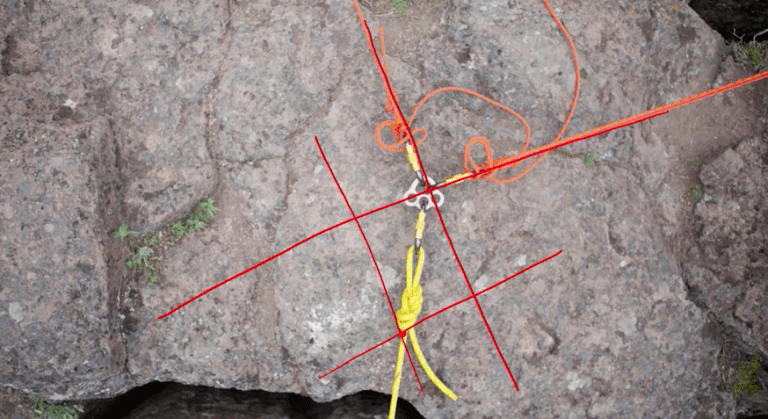
Understanding rigging involves grasping key concepts of trigonometry and vector physics. Rigging, at its core, is about managing force—its direction, magnitude, and impact on systems. To effectively study rigging, one must also study vectors, which combine both direction and magnitude to describe forces. This understanding is crucial for building safe and efficient rope systems.
Scalars and Vectors in Rigging
When discussing force, it’s essential to differentiate between scalar and vector quantities:
- Scalars: These describe a simple quantity, such as speed, which only indicates “how much” of something exists.
- Vectors: These incorporate both magnitude and direction, such as velocity, which specifies “how much” and “where.”
For example, knowing the speed of a falling object isn’t enough in rigging; you also need to understand the direction of the fall to plan and counteract the forces involved effectively.
What Are Force Multipliers?
Force multipliers are factors or conditions that increase stress within a rope system during dynamic operations. These multipliers impact the Dynamic System Safety Factor (DSSF), which measures the system’s weakest link under maximum stress—typically at the start of hauling or tensioning operations.
A deeper understanding of force multipliers can improve safety and efficiency, as they highlight critical stress points within a system.
Common Misunderstandings in Rope Rigging
Several aspects of rigging are often misunderstood, particularly in emergency response or urban technical rescue scenarios. These include:
- Force Vectors: Understanding how forces act in specific directions and how they combine at anchor points or pulleys.
- Tensile Force: Recognizing the stress placed on ropes and how to mitigate overloading.
- Compression Force: Identifying where compressive forces act on equipment or anchors.
- Friction: Factoring in how friction affects the efficiency of hauling and lowering systems.
- Torque: Understanding rotational forces and their implications on systems with moving parts or angled setups.
Applying Knowledge in Rigging Systems
When planning and operating rigging systems, understanding these concepts allows for better decision-making. It helps rescuers calculate load distribution, anticipate potential failure points, and design systems that maximize safety and efficiency. By mastering the interaction of forces within a system, teams can avoid common pitfalls and ensure robust setups.
To further your understanding of these principles, check out our in-depth resources:
For a deeper dive into rigging physics and best practices, explore more at Rigging Lab Academy.
Peace on your Days,
Lance


Comments are closed.