
Understanding Proper Carabiner Loading and Risks
A carabiner is a fundamental piece of equipment in vertical activities, designed to perform optimally when loaded on the major axis with the gate securely closed and the sleeve locked. Deviating from this intended use can significantly reduce strength and compromise safety. Here’s what you need to know about proper carabiner loading and the primary risks associated with misuse.
Proper Carabiner Loading
- Major Axis Loading:
Carabiners are engineered to handle maximum loads when aligned along the major axis. This alignment ensures the highest strength rating, making it suitable for vertical activities. - Improper Loading:
Loading a carabiner on the minor axis or in a poorly positioned state diminishes its strength drastically. Such scenarios can lead to equipment failure, especially under high stress or impact forces.
Load position
 Barring exceptional circumstances, a carabiner is designed to be loaded on the major axis.
Only the strength rating for the major axis with the gate closed is suitable for the loads sustained by a carabiner in vertical activities.
Loading on any axis other than the major axis, and any poor positioning will result in reduced strength.
THE PRIMARY RISKS
Risk of unclipping
 The gate can come open if:
- The carabiner is not properly closed at the time of attachment (e.g. sling caught between the nose and the gate).
- The carabiner was improperly closed or improperly locked before use and the rock, the rope or an item of equipment presses on the gate.
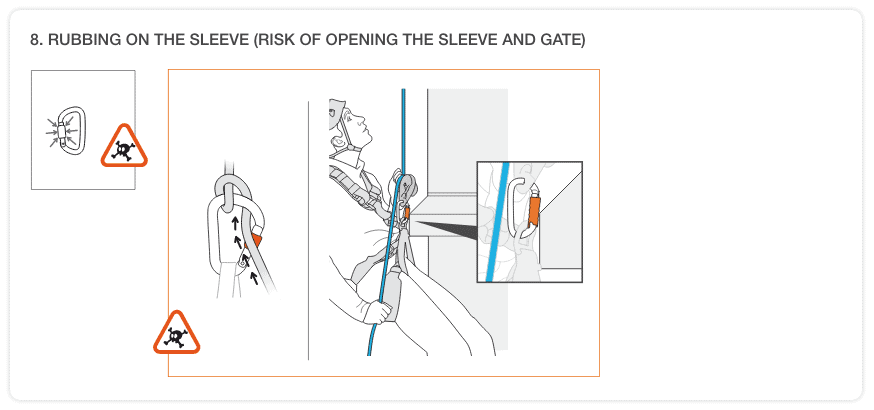
- The rock, the rope, or an item of equipment rubs against and unlocks the sleeve, and pushes on the gate in the direction of opening.
Primary Risks
- Unclipping Risks
The gate may open under certain circumstances:- Improper Closure:
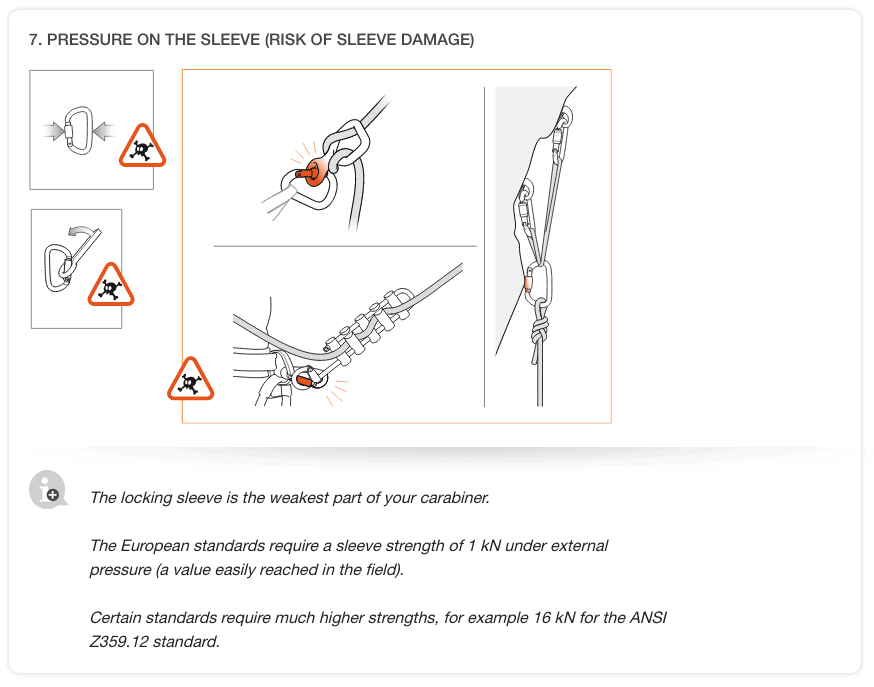
If a sling or rope interferes with the gate at the time of attachment, the carabiner might not close securely. - External Pressure:
Rock, rope, or gear pressing against an improperly locked gate can cause accidental opening. - Rubbing and Unlocking:
Friction against the sleeve can unlock the carabiner, opening the gate unintentionally.
- Improper Closure:
- Breakage Risks
While well-equipped individuals in vertical practices rarely generate enough force to break a properly loaded carabiner, a poorly positioned one can fail under impact forces.
Risk of carabiner breakage
Note: Vertical practices involving a single user who is properly equipped and protected from falls rarely generate enough force to break a carabiner. However, any fall can produce an impact force that approaches the breaking strength of a poorly positioned carabiner.
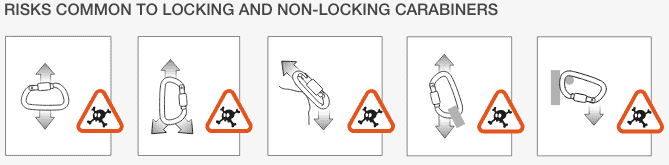
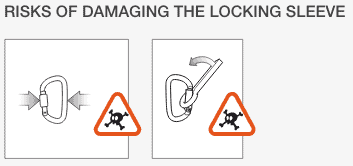
Examples of risk situations in the field
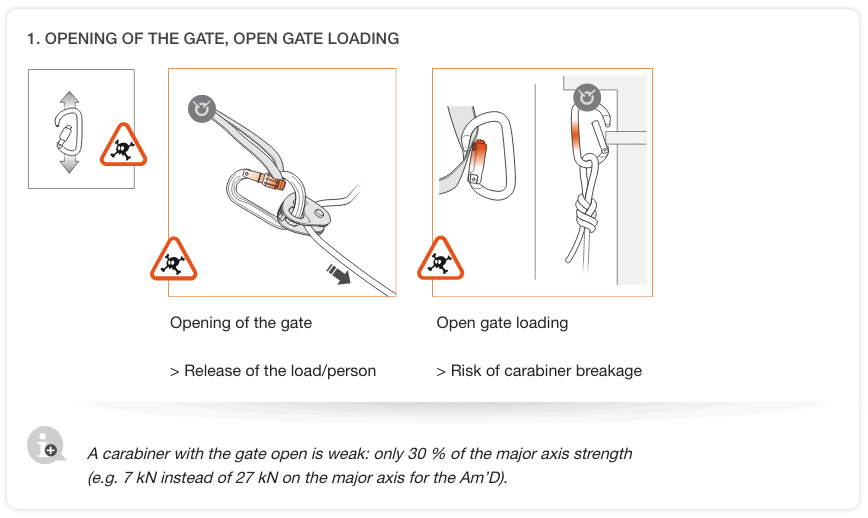
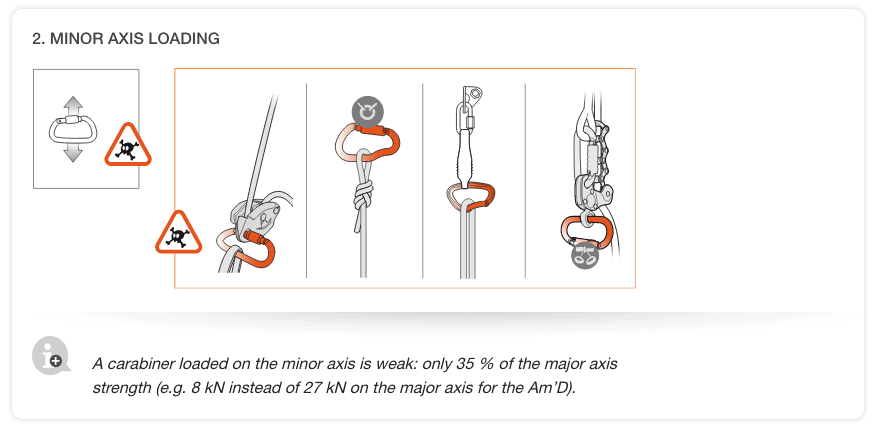
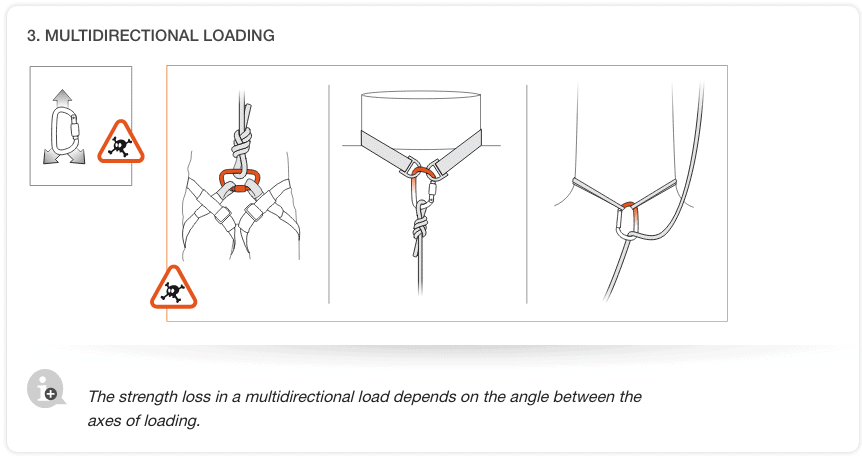
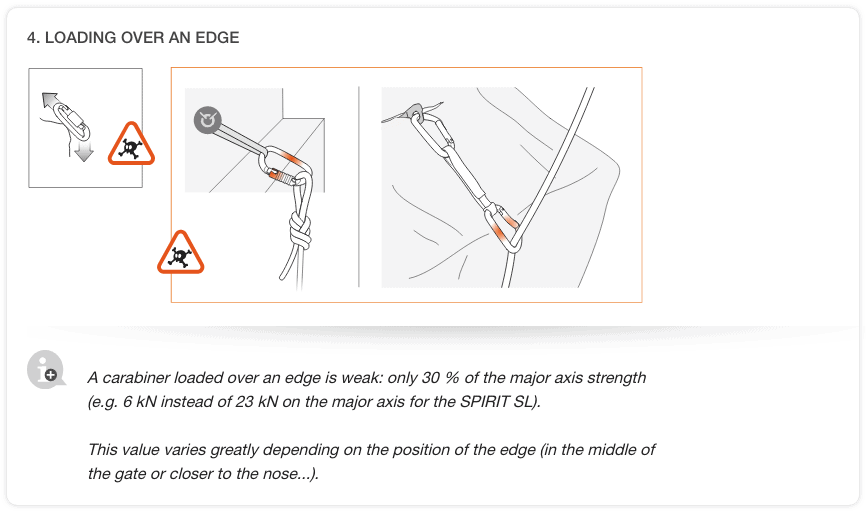
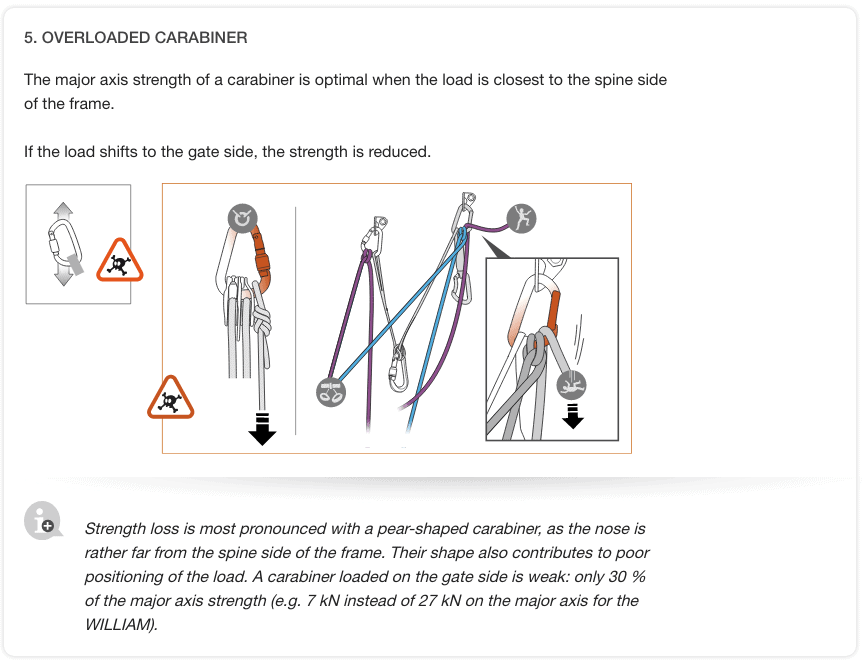

Examples of Risk Situations
- Open Gate Loading:
The carabiner gate remains open, exposing it to forces it cannot handle. - Minor Axis Loading:
The load applies perpendicular to the carabiner’s major axis, drastically reducing its strength. - Multidirectional Loading:
Forces pulling in multiple directions create instability and weaken the carabiner. - Loading Over an Edge:
Edges can cause uneven force distribution, increasing the likelihood of breakage. - Overloaded Carabiner:
Exceeding the carabiner’s load capacity, especially in suboptimal positions, can lead to catastrophic failure. - Cantilever Loads:
Uneven pressure on the carabiner leads to dangerous stress points. - Sleeve Damage or Rubbing:
Excessive pressure or friction can unlock the sleeve, resulting in gate failure.
Mitigating Risks
- Proper Use:
Always load carabiners on their major axis. - Secure Gate and Sleeve:
Check that the gate is closed and the sleeve is locked before use. - Avoid Abrasion:
Protect the sleeve from rubbing or external forces that could open it. - Routine Inspections:
Regularly inspect carabiners for signs of wear, damage, or deformation.
For a complete guide on carabiner use and best practices, explore our Petzl Carabiner Guide.
Peace on your Days
Lance




Comments are closed.