

ANSI Z459.1 and Twin Tensioned Systems: Clarifying Misconceptions
The ANSI Z459.1 standard, introduced as part of the ANSI Z359 Fall Protection Code, aims to provide clear guidance on rope access systems. However, misconceptions have arisen regarding the standard’s interpretation, particularly concerning the use of two descenders on a single connection point. This article aims to clarify these misunderstandings while outlining the scope and intent of the ANSI Z459.1 standard.
Purpose of ANSI Z459.1
The ANSI Z459.1 standard defines the parameters for typical rope access systems used in work-at-height scenarios. Its goal is to establish rope access as a legitimate and effective method of work while ensuring safety and compliance with federal regulations. A typical rope access system comprises:
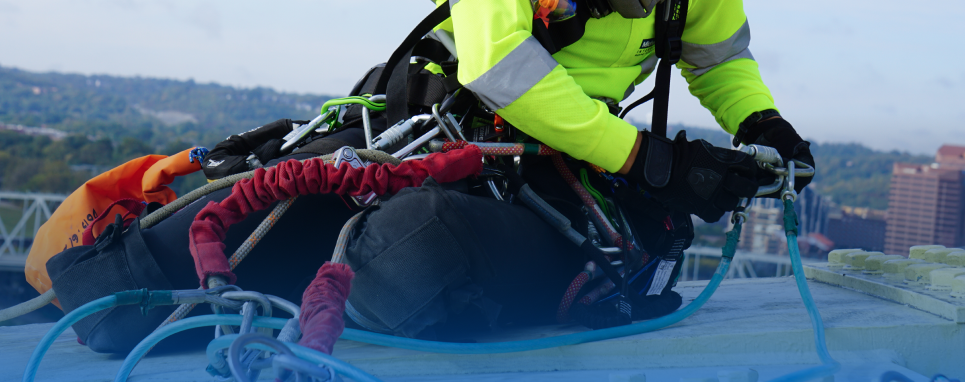
- Progress System: A descender or ascending system, typically connected to the ventral attachment.
- Backup System: A rope grab device connected to the sternal attachment, ensuring redundancy.
To qualify as rope access under ANSI Z459.1, the systems must:
- Include both a progress and a backup system.
- Be interchangeable, allowing the progress system to function on the backup line and vice versa.
Misconceptions About Simultaneous Attachment Points
A key clause in ANSI Z459.1 (Paragraph 3.2.2.2) states that the progress and backup systems should not simultaneously load the same attachment point. This has led to confusion, but the intent is clear:
- Compatibility and Safety: Simultaneous loading can cause compatibility issues, increasing the risk of system failure or roll-out.
- Redundancy Concerns: True redundancy means the failure of one component does not result in catastrophic failure. Simultaneously loading a single point compromises this principle.
While ANSI Z459.1 aligns with OSHA regulations prohibiting simultaneous attachments to a single D-ring, it allows exceptions during transitions, such as rope-to-rope transfers. In these scenarios, attaching multiple connectors to the same point is essential for safety and preventing swing falls.
Twin Tensioned Systems and Their Status
The Twin Tensioned System, sometimes called a dual-tensioned or mirrored system, is not addressed by ANSI Z459.1 because it is not considered a typical rope access system. These systems, often used in rescue operations, involve:
- Two descenders connected to the same harness point and operated simultaneously.
- Each rope sharing the load, reducing overall tension and shock loads in case of failure.
While this approach has historical roots in rescue operations, its use in rope access is specialized and situational. Employers wishing to implement such systems must rely on OSHA regulations and the oversight of a Qualified Person to ensure compliance with safety standards.
Key Takeaways
- ANSI Z459.1 Standard:
- Applies only to typical rope access systems.
- Requires separation of progress and backup systems to maintain redundancy.
- Aligns with OSHA regulations prohibiting simultaneous loading of a single attachment point except in transition scenarios.
- Twin Tensioned Systems:
- Are not typical rope access systems and are outside the scope of ANSI Z459.1.
- Require compliance with OSHA’s overarching fall protection guidelines.
- Can be implemented if addressed by a Qualified Person under OSHA’s variance provisions.
Final Thoughts
The ANSI Z459.1 standard offers critical guidance for rope access systems but does not encompass all work-at-height or rescue scenarios. Twin Tensioned Systems, while valuable in specific contexts, require careful consideration under OSHA’s fall protection regulations. Employers, technicians, and regulators are encouraged to consult the ANSI Z459.1 standard and OSHA guidelines to ensure compliance and safety.
For further details on the ANSI Z459.1 standard or Twin Tensioned Systems, visit Rigging Lab Academy for comprehensive resources and expert guidance.
Peace on your Days
Lance


Comments are closed.