Mechanical advantage systems are often selected by balancing two competing needs: the force required to move the load and the speed needed to complete the operation. A traditional set of fours provides useful force multiplication, but the amount of rope that must be pulled through the system can make movement comparatively slow.
The Fast Fours configuration modifies the traditional 4:1 system so operators can choose between greater mechanical advantage and faster rope movement without rebuilding the haul system. Richard Delaney demonstrates how a second progress-capture pulley creates two usable haul ends, allowing the system to operate as either a conventional 4:1 or a shared 2:1 haul.
That adaptability makes the Fast Fours particularly useful for fallen-worker recovery, confined-space retrieval, equipment hauling, and other operations where the load may initially move easily but become more difficult as conditions change.
Starting With a Standard Set of Fours
The Fast Fours begins with the same basic operating principle as a conventional set of fours.
In an ideal 4:1 mechanical advantage system, one unit of input force produces four units of force at the load. The system gains force by supporting the moving pulley assembly with four tensioned rope segments.
This relationship can be identified using the T-method:
- Assign one unit of tension, or T, to the haul strand.
- Follow that tension through the idealized rope system.
- Count the tension contributions acting on the moving load.
- Four contributing rope segments produce a theoretical 4:1 mechanical advantage.
This is an ideal calculation. Actual mechanical advantage will always be lower because pulleys, progress-capture devices, rope bends, misalignment, edge contact, and other system components introduce friction. Pulley efficiency is always less than 100 percent, so the force produced by a working system will not equal its ideal mathematical value.
The value of the 4:1 remains clear: it reduces the input force required from the operator. The tradeoff is that the operator must pull approximately four units of rope to move the load one unit.
What Makes the Fast Fours Different
In a conventional set of fours, the far end of the rope is normally terminated at the becket of a pulley. That termination creates one operating haul strand.
The Fast Fours changes this arrangement.
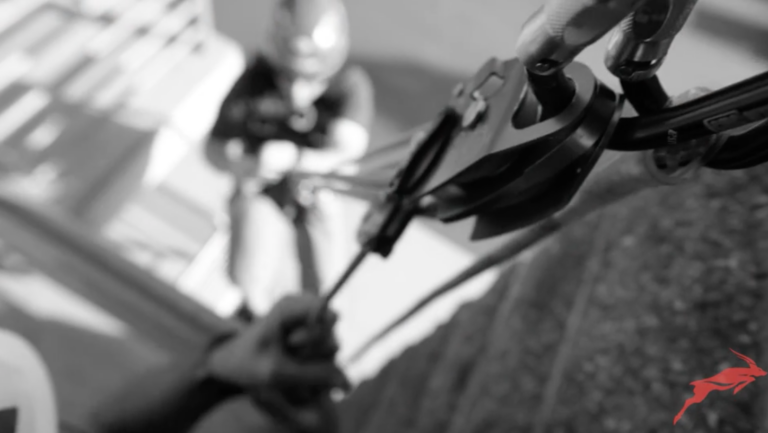
Instead of securing the far end directly to the becket, the rope is routed through an additional progress-capture pulley. In the demonstrated system, this function is provided by a Petzl MICRO TRAXION. The upper pulley is an SMC Advance Tech HX with progress capture integrated into one sheave.
This arrangement leaves two free operating ends.
That single change gives the Fast Fours two operating modes:
- Both rope ends can be pulled together for faster movement at a theoretical 2:1 mechanical advantage.
- One rope end can be pulled independently to return the system to a theoretical 4:1.
The system does not need to be dismantled or converted between these modes. The operator changes the way the existing rope ends are used.
Fast Mode With Two Haul Strands
When both free rope ends are pulled together, the load moves at a theoretical 2:1 mechanical advantage.
This mode requires more input force than the 4:1 configuration, but it moves the load more quickly. For every two units of rope pulled, the load moves approximately one unit in an ideal system.
This can be useful during the initial stage of a haul when:
- The load is relatively light.
- Friction is low.
- Several people are available to pull.
- Rapid rope recovery is more important than maximum force multiplication.
- The system is being extended or collapsed without a heavily loaded rescue package.
Pulling both strands does not preserve the 4:1 advantage. The system is now being operated through a different force relationship. Calling it a “fast 4:1” can obscure what is actually happening. The underlying rigging remains capable of providing 4:1 mechanical advantage, but the two-strand operating method provides a theoretical 2:1.
The speed comes from accepting less mechanical advantage, not from producing the same force with less rope travel.
Power Mode With One Haul Strand
As the load becomes heavier or resistance increases, the operator can stop pulling both strands and continue hauling with one strand.
The system then functions as the standard 4:1.
This transition may become necessary when:
- The load reaches an edge or obstruction.
- Rope contact introduces additional friction.
- The hauling team loses personnel.
- The worker can no longer assist.
- The package becomes harder to control.
- The operator requires more force and less speed.
The Fast Fours therefore allows the team to begin with faster movement and shift to greater mechanical advantage when conditions demand it.
This is the central operating advantage of the configuration. The team does not need to predict one fixed force requirement for the entire haul. It can change how effort is applied as the operation develops.
The Role of Progress Capture
Progress capture is fundamental to the Fast Fours configuration.
A progress-capture pulley permits rope movement in the hauling direction while limiting movement back toward the load. This prevents the system from losing the progress gained between pulls and allows the operator to reset without continuously holding the full load.
The Petzl MICRO TRAXION shown in the demonstration combines a pulley with a toothed cam. Petzl identifies it as a compact progress-capture pulley intended for hauling and self-rescue. Its cam can also be locked open when the device needs to function as a simple pulley. The current model is rated at 91 percent pulley efficiency under the manufacturer’s test conditions.
The SMC Advance Tech HX incorporates progress capture into one side of a double pulley. SMC describes the device as suitable for rapidly deployed mechanical advantage systems requiring progress capture. The current model accommodates 7 to 12.5 millimeter rope and has a listed 34 kN three-sigma minimum breaking strength.
These specifications should not be applied automatically to older equipment or visually similar devices. Operators must confirm the exact model, rope compatibility, loading limits, orientation, and manufacturer instructions for the equipment being placed into service.
Deploying the System
A useful feature of the Fast Fours is its ability to be extended toward a worker or load.
With the appropriate progress-capture mechanism placed in its open or parked position, the moving pulley assembly can be pulled away from the upper system. This allows the unit to be lowered or sent down to the person who needs to be recovered.
A basic deployment sequence may include:
- Establish and verify the supporting anchor.
- Confirm that the rope is correctly routed through both pulley assemblies.
- Place the required progress-capture device in the open position.
- Extend the moving assembly toward the worker or load.
- Establish and verify the load connection.
- Return the progress-capture mechanism to its operating position.
- Conduct a function check before applying the full load.
- Begin hauling using the selected operating mode.
The sequence is simple, but each step matters. A progress-capture device that remains parked open will not retain hauling progress. A rope routed outside the intended cam or sheave may not perform as expected. An incorrectly oriented connector can introduce cross-loading, interference, or restricted movement.
The operator should verify the assembled system rather than relying only on the fact that it was stored as a pre-rigged kit.
Fallen-Worker Recovery
One of the most practical Fast Fours applications is the recovery of a worker suspended below an elevated work position.
The upper operator can extend the pulley system to the fallen worker and send the second haul end down with it. When the worker is responsive and physically capable, the operator above and the worker below can each pull one rope end.
Both participants are then contributing to the same theoretical 2:1 haul. The work is shared, and the worker is not expected to raise their full body weight without assistance.
When resistance increases, the upper operator can shift to the single-strand 4:1 operating mode.
This can be particularly useful when the worker approaches the edge or when the upper operator must complete the final stage of the recovery without assistance from below.
OSHA requires employers to provide for the prompt rescue of an employee following a fall. A usable rescue method must therefore be established before work begins rather than improvised after a worker is already suspended.
The Fast Fours may support that plan, but it is not a complete rescue plan by itself. The team must still account for the anchor, worker connection, existing fall-arrest system, rope path, edge transition, communication, medical condition, and the possibility that the worker will be unable to assist.
Confined-Space Recovery
The same configuration may also be applied to selected confined-space operations.
A worker located below an opening may be able to assist by pulling one end of the system while the attendant or rescuer above pulls the other. When the shared haul is no longer sufficient, the upper operator can revert to the 4:1 mode.
This can be valuable during a controlled vertical recovery where:
- The entrant remains responsive.
- The rope path is direct.
- The opening permits passage of the worker and equipment.
- The retrieval connection is appropriate.
- Atmospheric and other space hazards are already being controlled.
- The system does not interfere with required entry or rescue equipment.
The Fast Fours should not be treated as a substitute for confined-space rescue planning. A permit-required confined-space emergency may involve atmospheric hazards, entanglement, restricted openings, patient packaging, attendant responsibilities, and entry-rescue requirements that extend well beyond the haul system.
Mechanical advantage moves the load. It does not resolve the entire incident.
Speed Versus Available Force
The Fast Fours illustrates an important rigging principle: speed and force multiplication are connected.
A system that provides greater mechanical advantage usually requires more rope travel. A system that moves the load more quickly generally requires greater input force.
The choice between the two Fast Fours operating modes should be based on the resistance present at that moment.
Use the two-strand 2:1 mode when:
- The load moves easily.
- Faster travel is useful.
- Two haul strands can be managed without confusion.
- The available operators can produce the required input force.
- The rope path remains controlled.
Use the single-strand 4:1 mode when:
- The load becomes difficult to move.
- Fewer haul personnel are available.
- Edge friction or obstruction increases resistance.
- Slower, more controlled movement is preferred.
- The lower worker cannot assist.
The operator should not wait until the system is completely stalled before changing methods. Increasing resistance can often be anticipated as a package approaches an edge, changes direction, enters a constriction, or transfers between surfaces.
Actual Performance in the Field
A Fast Fours should not be expected to deliver its ideal mechanical advantage under working conditions.
Every pulley introduces some loss. The progress-capture cam can add resistance. Rope diameter, construction, contamination, bends, edge contact, and loading alignment all affect performance.
The two operating modes should therefore be understood as theoretical 2:1 and theoretical 4:1 arrangements.
The actual effort required will be higher.
This distinction becomes important when a system is selected near the limits of the available hauling team. A theoretical calculation may show that the load can be moved, but friction and poor alignment may remove enough efficiency that the system performs poorly in practice.
The system must be tested under realistic loading, with the rope and devices the team will actually use.
System Inspection and Compatibility
Because the Fast Fours combines multiple pulleys, cams, connectors, rope paths, and progress-capture functions, compatibility must be evaluated across the complete system.
Before use, inspect:
- Rope diameter and condition.
- Correct rope placement in every sheave.
- Progress-capture cam orientation.
- Cam engagement and release.
- Pulley rotation.
- Side-plate closure.
- Connector locking and orientation.
- Becket and attachment loading.
- Anchor strength and direction.
- Rope clearance through the full operating range.
- Potential interference between components.
Personal fall-protection equipment must be inspected before use, and ropes and harnesses must be protected from cutting, abrasion, melting, and other damage. OSHA also requires compatibility between fall-protection components and connectors.
The rescue haul system and the worker’s fall-arrest system may serve different functions, but they interact during the recovery. The connection and transfer process must not unintentionally remove the protection already supporting the worker.
Training the Transition
Fast Fours training should focus on more than constructing the system.
Operators need to recognize when and why to change operating modes.
Training should include:
- Rigging the complete system from individual components.
- Inspecting a pre-rigged system after deployment.
- Extending the pulley assembly.
- Parking and reengaging progress capture.
- Operating the two-strand 2:1 mode.
- Transitioning to single-strand 4:1 hauling.
- Coordinating two operators at separate locations.
- Recovering a responsive worker.
- Continuing the haul when the worker stops assisting.
- Managing the final edge or opening transition.
- Responding to a misrigged or nonfunctioning progress-capture device.
The Fast Fours is useful because it provides options. Those options only improve the operation when the team understands what each mode produces and can make the transition without confusion.
A Versatile Set of Fours
The Fast Fours does not replace the traditional set of fours. It expands what the same basic system can do.
By routing the normally terminated rope end through a second progress-capture pulley, the operator gains two usable haul strands. Pulling both strands provides faster movement through a theoretical 2:1. Pulling one strand returns the system to the greater force multiplication of a theoretical 4:1.
That allows the team to adapt the haul as resistance changes.
For fallen-worker recovery, a responsive worker may share the effort from below. In a confined-space operation, an entrant may assist during the initial movement. During equipment hauling, the team may move rapidly until greater resistance demands additional mechanical advantage.
The value of the Fast Fours is not simply that it is faster or stronger. It allows the operator to choose which quality the operation needs at each stage of movement.