
What Happens Between
Rope Rescue Certification Training
One place your team comes back to. Review, retrain, and
keep the skill from fading between certification events.
Understand the System Before You Build It
The RLA Accelerator helps you work through real-world rigging problems by looking at the system, the conditions, and what you are trying to accomplish.
It helps you understand how your decisions affect forces, system behavior, and potential limits.
Join Rigging Lab Academy
How the RLA Accelerator Helps
You describe the system you're looking at. The Accelerator walks it with you and shows how it's likely to behave under load.
For instructors and team leaders, it's a way to explain a decision, check an approach, or see where the team's understanding needs work.
Why the Accelerator Can Be Trusted
The Accelerator works from what's inside RLA. Its own training, its own references, its own analysis of real rigging problems
That's what separates it from a generic AI answer. It's not guessing from the open internet.
It's reasoning from the same material your team is training on.
.
How the RLA Accelerator Thinks and Operates
The RLA Accelerator functions as a structured reasoning engine for technical rope rescue—translating inputs into validated, CORE-aligned decisions.

This video will facilitate #1
1. Interpretation & Analysis
The Accelerator interprets your input by identifying the rigging domain, operational context, constraints, and governing standards before any analysis begins.
- The rigging category (anchors, MA, redundancy, etc.)
- The operational context (rescue, industrial, remote, constrained environment)
- Relevant constraints and unknowns
- Applicable standards, training level, and safety considerations
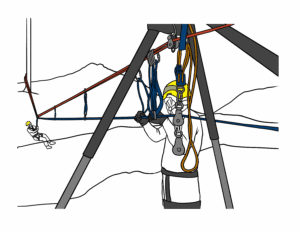
This video will facilitate #1
2. Knowledge Retrieval & Mapping
Instead of fetching generic answers, the Accelerator pulls precise, verified information from the RLA internal knowledge ecosystem, which includes:
- Lesson
- Technical documents
- Standards summaries
- Force diagrams
- Scenario explanations
- Best-ractice equivalencies
- Training-level competency
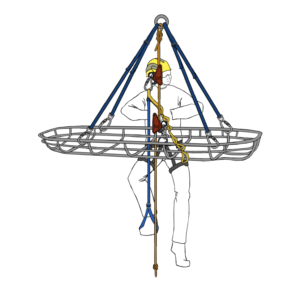
This video will facilitate #1
3. Diagnostic Reasoning
Once the Accelerator understands the input and knows what domain(s) it engages, it runs a diagnostic analysis.
This includes:
- Force and vector evaluation
- Mechanical advantage suitability and efficiency
- System geometry and redundancy checks
- Standards alignment (e.g., NFPA compliance)
- Risk identification and mitigation
- Equipment compatibility evaluations
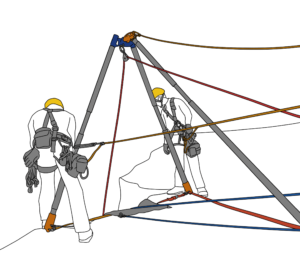
This video will facilitate #1
4. Tailored Output Generation
The Accelerator converts diagnostic results into actionable rigging plans, visual explanations, and decision-ready documentation.
- Force and vector evaluation
- Mechanical advantage suitability and efficiency
- System geometry and redundancy checks
- Standards alignment (e.g., NFPA compliance)
- Risk identification and mitigation
- Equipment compatibility evaluations
How the Accelerator Evaluates a Rigging System
It looks at anchors, forces, movement, equipment, and conditions
together to show how each choice affects the system.
1. Knots & Force Multipliers
How connections behave under load. How force gets introduced, redirected, or multiplied through the system.
2. Anchors & Anchor Systems
How loads get secured to the environment. Single-point, multi-point, and environmental anchors.
3. Mechanical Advantage
How force is generated and controlled during raising, lowering, and hauling.
4. Edge Safety & Belay Systems
How the team manages fall risk and edge transitions with redundant belay and protection.
5. Litter Operations
Patient packaging, attachment, and movement through vertical, horizontal, and complex terrain.
6. High Directionals & TTRS
Complex load paths, directional control, and mirrored-tension systems for advanced rescues.
7. Training, Program & Operational Leadership
How a team builds and holds technical capability over time. Training progression, standards, program readiness,
and the leadership calls that keep the program running.
Who the RLA Accelerator Is For
Built for rescuers, instructors, and team leaders who need to make sound rigging decisions
and keep training consistent across the team.
Operational Teams
- Fire Departments
- Search and Rescue Teams
- High Angle Rope Rescue Teams
- Confined Space Rescue Teams
- Urban & Industrial Rescue
Training, Leadership and Specialized Roles
- Training Officers
- Rope Rescue Instructors
- Technical Rescue Team Leaders
- Industrial Safety Professionals
- Administrators
- Law Enforcement
- Military Units
- Tactical
- Entertainment Riggers
- Tower Rescue Professionals
Consistent Training Produces Consistent Decisions

When Training Is Inconsistent
- Skills vary by shift, instructor, and memory
- Decisions rely on recall instead of verification
- Redundancy is assumed, not validated
- Confidence drops under time pressure
- Risk compounds silently

This video will facilitate #1
When Training Is Consistent
- Common technical language across shifts and instructors
- Training progression is structured and repeatable
- System decisions are reinforced through a shared core reference
- Instructors can identify and correct knowledge gaps consistently
- Teams build toward the same operational understanding
Used by Team Leaders, Instructors, and Operational Teams

This video will facilitate #1
“We stopped relying on memory and preference. Everyone is now building and checking systems the same way, and that has changed how we operate.”
This video will facilitate #1
“The biggest improvement wasn’t new gear or new techniques — it was finally having a shared baseline we could trust.”

This video will facilitate #1
“In steep and vertical work, small details matter. Having a system that forces those details to be checked has reduced hesitation and mistakes.”
The RLA Accelerator applies RLA’s training and technical
knowledge to real-world rigging decisions.

Rigging Lab Academy gives individuals, instructors, and teams a common foundation for understanding rigging systems and how they work.

RLA brings together rigging principles, physics, standards, system analysis, and practical training in one place.
