
The RLA CORE/Accelerator Is an
Operational Training System
It evaluates real-world rigging decisions against how
systems actually behave under load.
CORE Required for Accelerator Access
Evaluate the System Before You Build It
The RLA Accelerator evaluates real-world rigging and rope rescue decisions under constraint, under pressure, and within incomplete information.
It takes your configuration, environment, and intent—and maps them against the system behavior defined in RLA CORE.
It does not teach procedures or provide step-by-step answers.
It reveals how decisions interact with force, structure, and system limits.
Join Rigging Lab Academy
CORE Required for Accelerator Access
The Role of the RLA Accelerator
The RLA Accelerator evaluates real-world rigging decision-making.
You provide the setup, environment, constraints, and intent—and the Accelerator evaluates those inputs against known system behavior, showing alignment, conflict, and where risk is introduced.
Why the Accelerator Can Be Trusted
The Accelerator evaluates your setup against RLA CORE—the established rules of how rigging systems behave under load. It stays within proven system behavior, ensuring outputs remain grounded when decisions matter.
CORE Function
What It Contains
Operational Impact
Foundational Domains
Knots, Anchors, Mechanical Advantage, Litter Operations High Directionals & TTRS
Defines the components and mechanics present in any system.
Applied Analysis
Critical Analysis Studies, Incident Reviews, Study Guides
Shows how components behave under real conditions and how decisions influence outcomes.
Canonical References
Schematics, Reports, Standards
Provides authoritative material to verify assumptions and confirm correctness.
Media & Explanation
Videos, Podcasts, Maps, Quizzes
Translates system behavior into clear, usable understanding.
CORE Required for Accelerator Access
How the RLA Accelerator Thinks and Operates
The RLA Accelerator functions as a structured reasoning engine for technical rope rescue—translating inputs into validated, CORE-aligned decisions.

This video will facilitate #1
1. Interpretation & Analysis
The Accelerator interprets your input by identifying the rigging domain, operational context, constraints, and governing standards before any analysis begins.
- The rigging category (anchors, MA, redundancy, etc.)
- The operational context (rescue, industrial, remote, constrained environment)
- Relevant constraints and unknowns
- Applicable standards and safety considerations
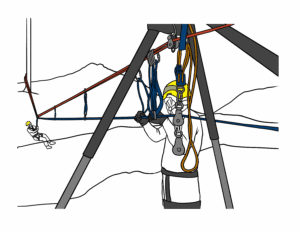
This video will facilitate #1
2. Knowledge Retrieval & Mapping
Instead of fetching generic answers, the Accelerator pulls precise, verified information from the RLA internal knowledge ecosystem, which includes:
- Lesson
- Technical documents
- Standards summaries
- Force diagrams
- Scenario explanations
- Best-ractice equivalencies
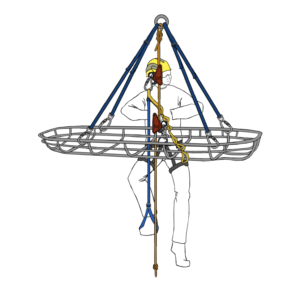
This video will facilitate #1
3. Diagnostic Reasoning
Once the Accelerator understands the input and knows what domain(s) it engages, it runs a diagnostic analysis.
This includes:
- Force and vector evaluation
- Mechanical advantage suitability and efficiency
- System geometry and redundancy checks
- Standards alignment (e.g., NFPA compliance)
- Risk identification and mitigation
- Equipment compatibility evaluations
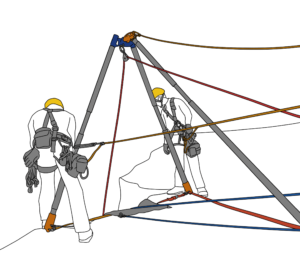
This video will facilitate #1
4. Tailored Output Generation
The Accelerator converts diagnostic results into actionable rigging plans, visual explanations, and decision-ready documentation.
- Force and vector evaluation
- Mechanical advantage suitability and efficiency
- System geometry and redundancy checks
- Standards alignment (e.g., NFPA compliance)
- Risk identification and mitigation
- Equipment compatibility evaluations
CORE Required for Accelerator Access
The RLA Core Domains of Operational Control
Rope rescue and rigging are not executed in steps. They operate as an integrated system where force, anchors, movement, and decision-making continuously interact. RLA CORE defines the seven functional domains that govern how rescue systems are built, evaluated, and controlled. The Accelerator reasons across these domains simultaneously, using them as its fixed reference for system behavior.
1. Knots & Force Multipliers
Defines how connections behave under load and how force is introduced, redirected, or multiplied within a system.
2. Anchors & Anchor Systems
Establishes how loads are secured to the environment, including single-point, multi-point, and environmental anchor logic.
3. Mechanical Advantage
Governs how force is generated, managed, and limited during raising, lowering, and hauling operations.
4. Edge Safety & Belay Systems
Controls exposure to fall risk and edge transitions through redundant belay and protection systems.
5. Litter Operations
Defines patient packaging, attachment, and movement logic for vertical, horizontal, and complex terrain rescues.
6. High Directionals & TTRS
Addresses complex load paths, directional control, and mirrored-tension operations required in advanced rescues.
7. Strategic Program & Legacy
Defines how systems align with NFPA/OSHA standards, scope of operations, and command-level responsibility for safe execution.
Who the RLA Accelerator Is Built For
The RLA Accelerator is built for professionals responsible for making correct rigging decisions under pressure—where system behavior, team safety, and operational outcomes are directly connected.
It supports both field execution and command-level oversight, using the same CORE reference to keep decisions consistent across roles, teams, and environments.
Operational Teams
- Fire Departments
- Search and Rescue Teams
- High Angle Rope Rescue Teams
- Confined Space Rescue Teams
- Urban & Industrial Rescue
Command, Oversight and Specialized Roles
- Industrial Safety Professionals
- Administrators
- Law Enforcement
- Military Units
- Tactical
- Entertainment Riggers
- Tower Rescue Professionals
CORE Required for Accelerator Access
"The difference between failure and control in rope rescue is not effort or experience — it is whether training produces verified, repeatable decisions under pressure."

Fragmented Training Environments
- Skills vary by shift, instructor, and memory
- Decisions rely on recall instead of verification
- Redundancy is assumed, not validated
- Confidence drops under time pressure
- Risk compounds silently

This video will facilitate #1
Standardized Training Environments
- Skills vary by shift, instructor, and memory
- Decisions rely on recall instead of verification
- Redundancy is assumed, not validated
- Confidence drops under time pressure
- Risk compounds silently
CORE Required for Accelerator Access
Used and reviewed by RLA Command Leaders

This video will facilitate #1
“We stopped relying on memory and preference. Everyone is now building and checking systems the same way, and that has changed how we operate.”

This video will facilitate #1
“The biggest improvement wasn’t new gear or new techniques — it was finally having a shared baseline we could trust.”

This video will facilitate #1
“In steep and vertical work, small details matter. Having a system that forces those details to be checked has reduced hesitation and mistakes.”
CORE Required for Accelerator Access
The RLA Accelerator is the operational reasoning engine within Rigging Lab Academy. It supports rigging decisions by interpreting operational context, identifying the governing CORE domain, and reasoning against the RLA canonical knowledge system.

Rigging Lab Academy is a rigging education ecosystem designed to teach technical rigging principles in a clear, practical, and operationally grounded way.

RLA CORE is not a collection of videos or courses. It is a structured, authoritative knowledge system built around rigging logic, physics, standards, and safety.

RLA CORE is grounded in the fundamentals of Technical Rope Rescue (TRR) and related disciplines used in fire rescue, SAR, industrial rope access, arboriculture, and other rigging-intensive environments.
Your RLA Membership Provides:
- RLA CORE Knowledge System (7 Foundational Domains): Full access to the canonical rigging knowledge structure that defines correct system behavior across all operational domains.
-
Verified Technical Schematics & Study References:
Load-tested diagrams, force models, and reference materials used by the Accelerator to evaluate system geometry and decision validity. -
Critical Analysis & Scenario Review Library:
Structured breakdowns of system failures, edge cases, and complex operations used to develop repeatable judgment under pressure. -
Authoritative Digital Reference Library:
A consolidated technical library supporting anchors, MA systems, redundancy, edge safety, litter operations, and high-directional environments. -
Ongoing Competency Validation:
Assessments and checkpoints designed to expose gaps in understanding and reinforce CORE-aligned decision making. -
Command-Level Decision Flow Visuals:
Structured visual frameworks that mirror how the Accelerator evaluates choices—supporting rapid, defensible decisions in real operations.
